How to Buy Woven Labels Wholesale Without Quality Trade-Offs
Buying woven labels wholesale should lower your cost per piece, not lower the standard of your brand. The challenge is that every label detail becomes more important at volume. A tiny readability issue, a rough edge or a slightly wrong color may seem manageable on 50 pieces, but it becomes expensive when repeated across thousands of garments.
The best wholesale order starts before you ask for a price. It comes from clear specifications, a supplier who understands production and a proofing process that catches problems early. When those pieces are in place, you can scale your labels without making them look generic, flimsy or rushed.
Wholesale price is not the same as cheap quality
When people search for woven labels wholesale, they often compare suppliers by unit price first. That is understandable, especially for growing apparel brands, handmade product sellers and promotional merchandise companies managing tight margins. But the lowest unit price can become the most expensive option if labels arrive with blurry text, inconsistent colors or a finish that irritates customers.
A true wholesale approach saves money through volume, efficient production and repeatable specifications. It should not rely on weaker materials, poor weaving or reduced quality checks. In practice, a strong wholesale quote is built around a label design that can be produced cleanly again and again.
Judge quality by the factors your customer will actually feel and see: legibility, color consistency, edge finish, comfort against the skin, durability after wear and how closely the finished label reflects your brand identity. If a supplier cannot explain how they protect those factors at scale, the price alone does not tell you enough.
Start with the finished product, not the label quote
Before requesting wholesale pricing, define where the label will live and what job it needs to do. A neck label on a soft T-shirt has different requirements than a hem tag on denim, a label for knitwear or a woven patch for outerwear. Placement affects size, fold, texture, thread density and how much detail your design can hold.
For clothing brands, it also helps to separate branding labels from care or compliance information. In the United States, the Federal Trade Commission provides guidance on textile labeling and care instructions through its Textile, Wool, Fur, Apparel and Leather Matters resource. A woven brand label can carry your logo beautifully, but care content may need a different format depending on the garment and legal requirements.
If you are still deciding on label style, size or placement, HiLabels has a practical guide on choosing personalized woven labels for your brand that can help you narrow the brief before you request a wholesale quote.
A good supplier brief should include your garment type, label placement, target size, fold preference, color needs, artwork file, expected quantity and whether you expect to reorder. That last point matters because repeat orders are where wholesale planning really pays off. A label that is easy to reproduce keeps your brand consistent across seasons, product drops and retail channels.
Specifications that protect quality at scale
Wholesale label quality depends on the small decisions that shape production. The table below shows the specifications most likely to affect the finished result.
| Specification | Quality decision to make | Common wholesale mistake |
|---|---|---|
| Artwork detail | Simplify fine lines and tiny elements so they can be woven cleanly | Sending a complex logo designed for print without adapting it for thread |
| Label size | Choose a size that gives text and logo elements enough breathing room | Shrinking the label to save cost until the design becomes hard to read |
| Thread colors | Limit colors to what the design truly needs | Adding extra shades that raise complexity without improving the result |
| Fold type | Match the fold to placement and sewing method | Choosing a fold based only on appearance rather than garment construction |
| Edge finish | Use a finish that feels comfortable and resists fraying | Ignoring how the label will feel against skin or behave after washing |
| Background contrast | Make sure the logo and text stand out clearly | Choosing brand colors that look good on screen but lack contrast in thread |
| Reorder consistency | Keep approved specs, proofs and samples on file | Recreating the label from memory or a low-resolution image later |
Woven labels are made from thread, so artwork has to translate into a physical weave. Gradients, small lettering and hairline details often need adjustment. That does not mean your design must be boring. It means the design needs to be prepared for the medium.
If your order centers on a brand mark, review the steps in HiLabels’ guide to ordering woven labels with your own logo before locking in the wholesale run. A few artwork changes before production can prevent a large batch of labels from looking less polished than intended.
Use proofing to prevent expensive surprises
Wholesale orders amplify mistakes, so proofing is not a formality. It is the stage where you confirm size, text, color placement, fold direction and overall layout before production begins. For a small test batch, you might tolerate minor uncertainty. For a larger order, every assumption should be checked.
A digital proof helps you confirm the layout, but remember that screen color is not the same as thread color. If color matching is central to your brand, ask how the supplier handles thread selection and whether your chosen palette can be woven accurately. If you are ordering labels for a premium garment, a physical sample or a smaller first run can be worth the extra step.
Proofing should answer practical questions. Is the logo readable at the selected size? Does the fold place the artwork in the right position after sewing? Is the background too dominant? Will the label still look balanced if it is sewn into a seam? These questions are much cheaper to resolve before production than after delivery.
HiLabels also offers an online creation process and artwork upload options, which can make it easier to translate your design into production-ready label details. If you want to reduce guesswork during setup, the article on how to design your own woven labels online is a helpful companion.
Vet the supplier like a production partner
A wholesale label supplier is not just a vendor selling small pieces of fabric. They are part of your product experience. Their work appears on every item you ship, often for the entire life of the garment. That makes communication, manufacturing consistency and service just as important as the quote.
Ask direct questions before you commit. How long has the supplier been making labels? What loom quality do they use? Can they handle reorders consistently? Do they help flag artwork that may not weave cleanly? What options do they offer if you need woven labels, care labels, patches, zipper pulls or ribbons from the same source?
This kind of supplier evaluation matters in any custom B2B purchase. For example, a specialist such as Peters Koelwagens makes process, certification and service information visible because buyers need confidence before investing in custom vehicle solutions. Label buyers should look for the same kind of clarity: evidence that the supplier understands specifications, repeatability and after-order support.
HiLabels brings more than 31 years of experience to custom woven labels, patches, ribbons, zipper pulls and care labels. That history matters because many quality problems are not dramatic production failures. They are small, preventable issues that experienced label makers know how to spot before they become expensive.
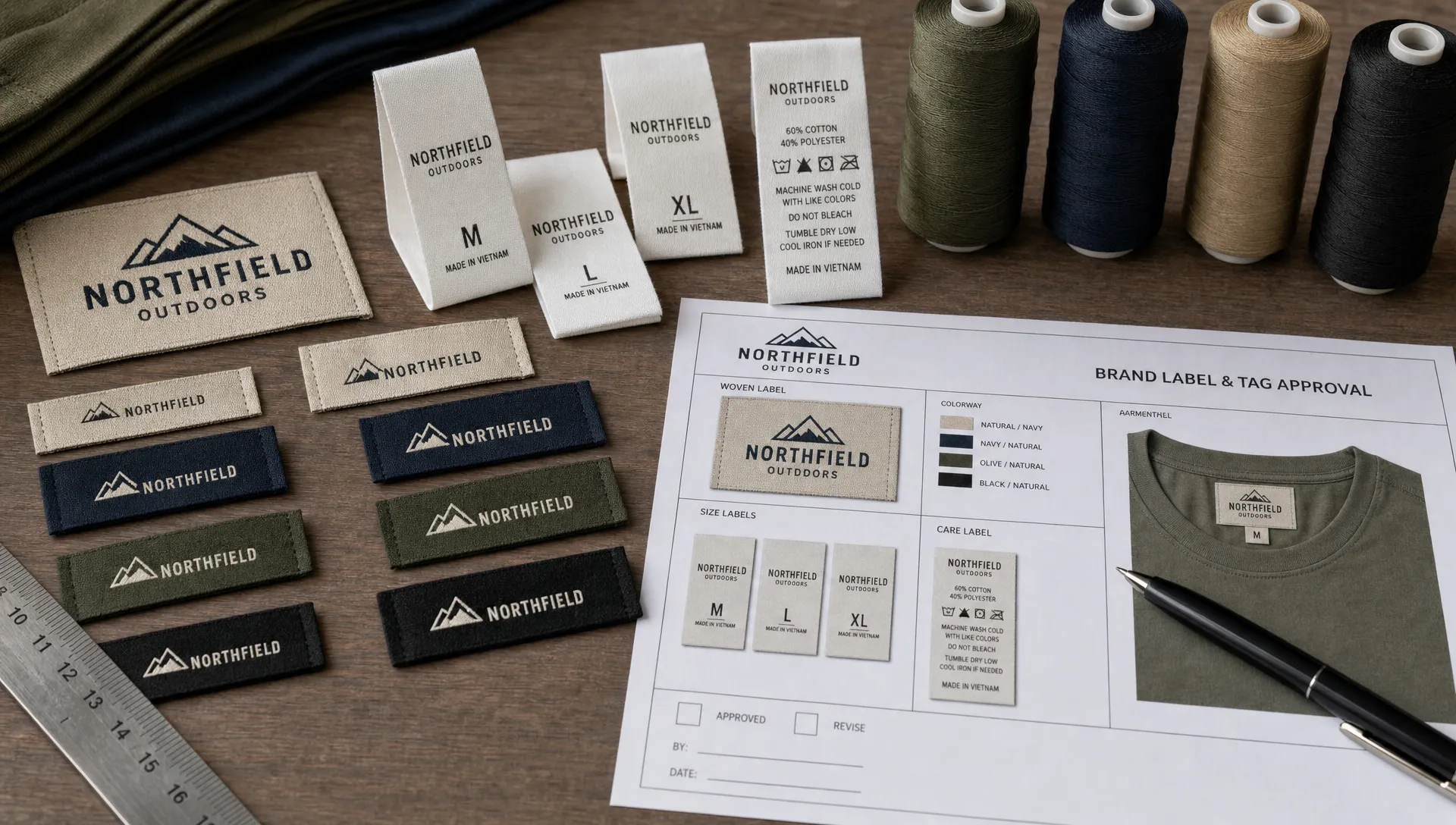
Lower cost without making the label look cheap
The safest way to reduce wholesale cost is to remove waste, not value. A label should still feel intentional, legible and aligned with your brand. The savings should come from better planning, efficient sizing and cleaner artwork, not from compromising the parts customers notice.
| Cost-control lever | Quality-safe approach | Risky alternative |
|---|---|---|
| Order quantity | Buy enough for your upcoming production and likely reorders | Overbuying before your design is fully proven |
| Label size | Choose the smallest size that still preserves readability | Making the label too small for the logo or text |
| Color count | Use a focused palette with strong contrast | Keeping unnecessary colors that complicate weaving |
| Artwork | Simplify details for a cleaner woven result | Forcing print-style detail into a woven format |
| Product range | Standardize one core brand label across multiple items | Creating too many small variations too early |
| Timing | Order before production deadlines become urgent | Paying more or accepting rushed decisions late in the process |
One overlooked wholesale strategy is standardization. If your core logo label can work across several garments, you may be able to order a larger quantity with greater consistency. Seasonal or limited-edition details can then be handled through hangtags, patches, ribbons or packaging rather than changing the main woven label every time.
Another smart approach is to think in reorder cycles. If you know your best-selling products will continue, design a label that can stay consistent for a long period. Reorders are simpler when the supplier has clear files, confirmed specifications and a previous approved sample to match.
A practical workflow for buying woven labels wholesale
A structured workflow helps you avoid rushed decisions and gives the supplier what they need to quote accurately. Use this sequence before placing a larger order.
- Define the label’s purpose: Decide whether the label is for branding, sizing, care information, decoration or a combination of functions.
- Confirm placement: Choose the exact location on the product, such as neck seam, side seam, hem, sleeve, bag interior or accessory edge.
- Prepare production-ready artwork: Use a clean logo file and simplify details that are too fine for weaving.
- Choose size, fold and colors: Make these decisions based on the garment and the customer experience, not only the lowest cost.
- Review the proof carefully: Check spelling, logo proportions, orientation, fold direction and contrast before approval.
- Test when the risk is high: Use a sample or smaller first order if the label is new, complex or central to a premium product line.
- Document approved specs: Save the proof, invoice details, thread colors, size, fold and a physical sample for future reorders.
This process may feel slower at first, but it usually speeds up every order after the first one. The more precise your approved standard becomes, the easier it is to buy woven labels wholesale without reopening every design decision.
Inspect the first shipment like a brand owner
Quality control does not end when the order arrives. Open the shipment before your sewing team or factory starts using the labels. Compare the delivered labels to the approved proof and, if available, the approved physical sample.
Look at the first labels from multiple bundles rather than only the top of one stack. Check that the size is consistent, folds are correct, edges are clean and the logo is readable. If the label will touch skin, feel the back and edges. If it will be sewn into a heavy garment, confirm it holds its shape and does not look too delicate for the product.
It also helps to sew a few labels onto actual garments before the full production run begins. A label can look perfect on a table but feel too stiff on lightweight fabric or sit awkwardly in a curved seam. Testing on the product reveals those issues before they reach customers.
Keep a small set of approved labels in your records. This gives you a real-world reference for future reorders and makes it easier to discuss any variation with your supplier.
Common mistakes to avoid
The first mistake is treating wholesale labels as a commodity. A woven label is small, but it is one of the most permanent branding elements on the product. Customers may remove packaging and discard hangtags, but the sewn-in label often stays.
The second mistake is approving artwork that was never adapted for weaving. A logo that looks sharp on a website, business card or printed hangtag may need simplification to look premium in thread. This is especially true for thin lettering, small icons and complex illustrations.
The third mistake is ordering too much before the design is proven. Wholesale pricing can tempt brands to buy the largest possible quantity right away. If the label size, fold or color is not fully tested, a smaller first run may protect you from a larger loss.
The fourth mistake is ignoring comfort. A beautiful label can still hurt the customer experience if it scratches the neck or feels too heavy for the fabric. Always match the label construction to the garment, especially for children’s clothing, activewear, sleepwear and lightweight knits.
Frequently Asked Questions
What is the best way to buy woven labels wholesale without losing quality? Start with clear specifications, production-ready artwork and a careful proofing process. Choose a supplier that can explain material, weave, fold and reorder consistency rather than comparing only unit price.
Should I order a sample before a wholesale woven label order? A sample or smaller first run is useful when the design is new, the logo has fine detail or the label will be used on premium products. It helps confirm comfort, readability and placement before you commit to a larger quantity.
How can I reduce the cost of wholesale woven labels? Reduce cost by standardizing a core label, choosing an efficient size, simplifying artwork and ordering with enough lead time. Avoid savings that hurt legibility, edge quality or comfort.
Are woven labels better than printed labels for bulk orders? Woven labels are often preferred for brand labels because the design is created with thread and feels integrated into the product. Printed labels can be useful for detailed care information or certain applications, so the best choice depends on the label’s purpose.
What files should I prepare before ordering wholesale labels? Provide the cleanest logo or artwork file you have, along with size, colors, fold preference, placement and quantity. If you have an approved previous label, include a photo or physical sample for reference.
Build your next wholesale label order with confidence
Buying woven labels wholesale should make your production more consistent, not more uncertain. When you define the label’s purpose, simplify artwork for weaving, review proofs carefully and choose a supplier with proven manufacturing experience, you can protect both your budget and your brand presentation.
HiLabels helps brands create custom woven labels, care labels, patches, zipper pulls and ribbons with a user-friendly ordering process, artwork upload options and experienced support. If you are ready to prepare a bulk order without compromising quality, start by exploring custom woven labels from HiLabels.


