How to Organize Laundry Name Tags for Shared Households
In a shared household, laundry name tags work best when everyone follows the same system. A readable name helps, but consistent placement, clear ownership rules and designated sorting baskets are what get clean clothes back to the right person.
That matters when roommates own identical black T-shirts, siblings wear similar sizes or a relative’s clothing travels between home and a care setting. You do not need to label every textile immediately. Start with the items that regularly get mixed up, then build a routine everyone can follow.
Separate ownership information from garment-care instructions
An ownership label answers “Whose is this?” A garment-care label answers “How should this be cleaned?” Neither replaces the other.
Keep the original washing, drying and ironing instructions readable when adding identification. Covering a care symbol might solve a sorting problem while creating a shrinking or heat-damage problem. If those symbols are unfamiliar, this guide to common wash symbols and their meanings can help.
Ownership also should not determine which clothes go into a load. Two garments belonging to the same person may need completely different treatment. Group laundry by compatible care requirements first, then return clean items by owner.
For truly communal items, such as kitchen towels or shared guest bedding, use a household designation rather than assigning an individual owner.
Organize laundry name tags with a household key
Choose one identification format before labeling clothes. Mixing full names, unexplained initials and changing nicknames creates unnecessary decoding work.
For most households, a first name or unique set of initials is enough. If two people share initials, add a distinguishing letter or use short names instead. Color can provide a secondary cue, but written identification should remain the primary reference.
A simple household key might look like this:
| Identification | Meaning | Clean-laundry destination |
|---|---|---|
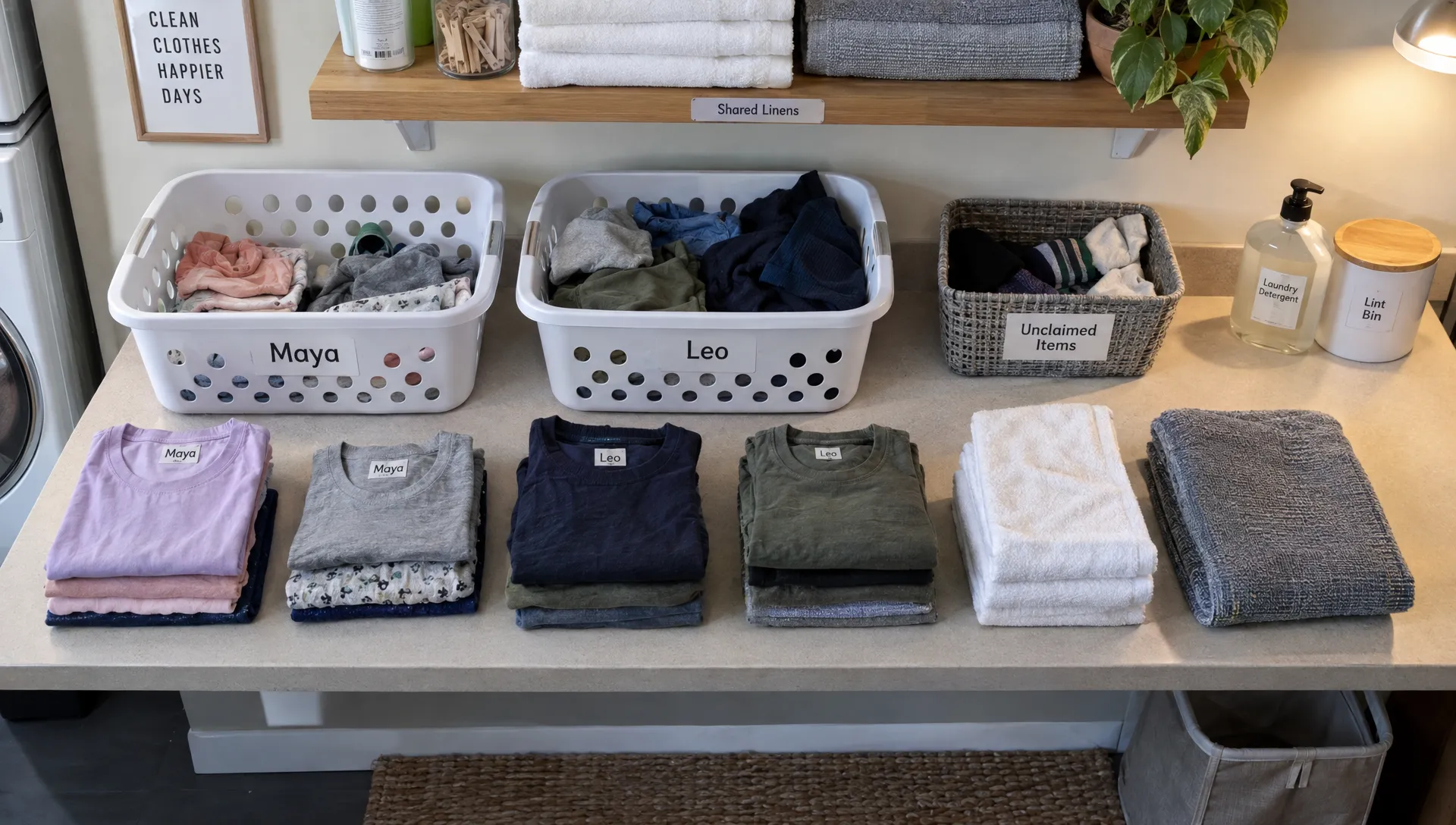
| Maya | Maya’s personal clothing | Maya’s basket |
| Leo | Leo’s personal clothing | Leo’s basket |
| HOUSE | Communal towels and linens | Shared linen shelf |
| ASK | Temporary sorting-basket label, not a garment label | Unclaimed-items basket |
The key makes laundry name tags useful to anyone helping with the washing, including a visiting relative or a new roommate. Keep it beside the sorting area rather than expecting people to memorize it.
Use only the personal information the setting requires. An internal household label rarely needs an address, phone number or date of birth. If clothing goes to a care facility, ask about its identification rules before choosing the wording. A household code may not be sufficient there.
Put identification where people will actually look
Agree on a small number of predictable locations. The exact spot can vary by garment, but nobody should need to search every seam.
For tops, start by checking the inside neck area or an accessible side care tag. For trousers, consider an inside waistband location. For towels and bedding, choose a consistent corner near the existing care label. These are starting points, not universal application instructions: the attachment method and fabric must be compatible.
For adhesive products, follow the manufacturer’s instructions about approved surfaces. A sticker intended for a smooth care tag may not adhere reliably to textured fabric. The guide to placing name stickers on clothes explains that distinction in more detail.
Check placement with the person wearing the item, especially around necklines, waistbands or sensitive skin. A technically secure label is not useful if it irritates the wearer and gets removed.
For tagless garments, do not improvise with high heat or adhesive. Check the garment and label instructions first. Delicate knits, silk, waterproof materials and specialty finishes may require particular care. If laundry name tags cannot be attached safely, keep the item in a designated hand-wash or special-care container until you have a suitable solution.
Choose attachment methods with future changes in mind
For household organization, the most useful distinction is often how identification can be changed when an item gets passed on. No method is universally washable, removable or residue-free.
| Method | Useful consideration | Removal or reassignment issue |
|---|---|---|
| Care-tag adhesive label | Convenient when the product is approved for that tag surface and wash routine | May leave residue or damage the tag during removal |
| Iron-on label | Requires fabric that tolerates the specified application heat | Can be difficult to remove and may leave adhesive or a visible mark |
| Sew-in label | Needs a suitable attachment point and secure stitching | Stitches can be unpicked, but careless removal can damage fabric |
| Fabric stamp | Depends on compatible ink, fabric and curing instructions | The mark may remain after ownership changes |
If hand-me-downs are common, plan for reassignment before labeling a whole wardrobe. A replaceable sewn label may suit some garments, while a manufacturer-approved removable product may suit others.
Test one representative item before doing a batch. Apply the label correctly, allow any required setting time and run the item through its normal washing and drying routine. Check attachment, readability, comfort and fabric condition afterward.
A successful home test supports that particular combination of garment, label and routine. It does not establish that laundry name tags will withstand every wash temperature, dryer setting or commercial laundry process.
Create a small sorting and labeling station
Keep the supplies together where laundry decisions happen. A small box or drawer is enough for unused labels, the household key and any tools required by your chosen attachment method. Store needles, scissors and other sharp tools securely, away from children.
Separate new or unidentified clothing from items that are ready for routine washing. This prevents a familiar problem: a new sweatshirt enters the wash before anyone records who owns it.
Your station needs only a few clear destinations:
- Ready to label: Newly purchased or newly assigned clothing whose owner is known.
- Needs repair: Items with loose stitching, peeling edges or unreadable identification.
- Owner unknown: Clean items waiting for someone to claim them.
- Ready to return: A basket or shelf space for each person’s clean laundry.
These can be small containers or marked sections of an existing shelf. There is no need to buy a complete organizing system.
Keep supplies separate from detergent spills and damp textiles. If you use a written inventory, limit it to easily confused or valuable items rather than cataloging every sock. The purpose is to reduce work, not create another household chore.
Use the same routine for every load
Before washing: check ownership and care separately
Ask each person to put unfamiliar or newly acquired clothing in the labeling area before its first shared wash. Check pockets and separate garments according to their care instructions as usual.
A quick glance at laundry name tags can catch missing identification before an item becomes anonymous. If ownership is unclear, ask rather than writing a guessed name onto the garment.
For small items, an owner-specific mesh laundry bag may help keep compatible socks or underwear together. Follow the bag’s instructions, avoid overfilling it and remember that a bag does not make an unsuitable wash cycle safe.
After drying: sort directly into the right destination
Sort clean items into each person’s basket before folding if that reduces handling. Keep the household key visible so another person can take over without needing an explanation.
If identification is missing or unreadable, put the item in the unclaimed basket instead of guessing from size or style. Ask household members to check that basket at a regular time, such as when collecting their clean clothes.
Once an owner claims an item, repair its identification before it re-enters the normal laundry cycle. Otherwise, the same garment will keep returning to the unclaimed pile.
Update the system when ownership changes
Treat reassignment as a small handover task. Before a sibling inherits a hoodie or a roommate takes over spare bedding, remove or replace the old identification where practical.
Leaving two equally prominent names creates ambiguity. If an old permanent mark cannot be removed safely, establish one clearly readable current identifier without obscuring care instructions. Check the garment after any removal attempt for adhesive, loose threads or fabric damage.
The household key should change at the same time as the clothing. Laundry name tags cannot prevent mix-ups if the label says one thing and the sorting chart says another.
Build a quick inspection into folding rather than scheduling a separate labeling session. Look for peeling corners, fraying attachments and faded text. Set affected items aside for repair, then return them to circulation once the identification is secure and legible.
If labels repeatedly fail, investigate the cause before replacing them with the same product. The attachment surface, application process or washing conditions may be incompatible. For clothing sent outside the home, confirm the receiving laundry’s requirements rather than relying on a household wash test.
Frequently asked questions
Does every item need an individual name label? No. Prioritize clothes that get confused, leave the home or regularly end up in the wrong basket. Distinctive items may not need identification, while similar uniforms, socks and towels often benefit from it.
Can I use color instead of a name? Color works best as a backup cue. Similar shades, poor lighting and differences in color perception can make a color-only system difficult to use. Pair it with a readable name, initials or an agreed household code.
Which labels are easiest to remove? Removal depends on the product, fabric, application and wash history. Some adhesive labels are designed to be removable, while sewn labels can often be detached by carefully unpicking their stitches. Neither approach guarantees a mark-free result. Follow the manufacturer’s removal instructions and avoid pulling forcefully.
Should shared towels have someone’s name on them? Only if the household assigns those towels to individuals. Otherwise, laundry name tags can identify them as communal property with a word such as “HOUSE.” Keep personal and shared designations distinct so the sorting routine stays clear.
Plan the wording before ordering
Start with one basket of frequently confused clothing. Agree on identifiers, test suitable placement and run a complete wash-and-return cycle before expanding the system.
When you are ready to create matching identification, explore HiLabels’ custom woven labels. Prepare your wording and intended attachment location first, then confirm that your selected label option suits the garments and laundry routine you use.


