How to Choose a Quiet Military Zipper Pull for Field Gear
A quiet military zipper pull should give you a secure grip without adding a metallic rattle every time your pack moves. Soft material helps, but the attachment matters just as much: a cord extension will not silence a loose metal tab underneath it. The right choice depends on your existing slider, the gloves you wear and the surfaces the pull can strike. Before ordering replacements or specifying pulls for a gear line, check the complete assembly rather than choosing by color or advertised strength alone.
Start with the source of the noise
Zipper noise comes from several places. The teeth and slider make sound during operation, while loose tabs, split rings and neighboring hardware can knock together during movement. Changing the pull mainly addresses that second category. It will not make the zipper chain itself silent.
With the compartment closed, gently shake the empty bag. Then repeat with its normal contents and straps secured. Hold the pull still and compare the sound. If the rattle disappears, the pull assembly is a useful place to start. If it remains, inspect adjacent buckles, clips and the second slider on a two-slider opening.
A military zipper pull is most useful for noise reduction when it removes unnecessary hard contact, not simply when it adds a softer gripping surface. Check whether it can hit another tab, the slider body or a nearby attachment point. Shortening the assembly or eliminating an unnecessary connector may help more than changing its visible grip.
Identify what actually needs replacing
Pull tab versus complete slider
The pull tab is the part you hold. The slider is the body that brings the zipper teeth together or separates them. A cord extension attaches to an existing tab or a suitable attachment point; it does not replace the slider.
If the zipper closes normally but the gripping tab is missing, a compatible replacement pull may be sufficient. If teeth separate behind the slider, the slider is cracked or its attachment bridge is broken, changing the pull will not repair the underlying fault. Inspect the chain as well, since damaged teeth can require a more extensive repair.
Before buying a military zipper pull, establish whether you need an extension, a replacement tab or a complete slider. Product listings sometimes blur those categories, so inspect the attachment photographs rather than relying on the product name.
Check chain type, size and attachment geometry
Identify whether the zipper uses coil, molded plastic teeth or metal teeth. On a reverse-coil zipper, the coil may face inward and be less visible from outside. Photograph both sides if you cannot identify it confidently.
For a complete slider replacement, match the manufacturer's zipper system, chain type, size and orientation. A number such as #5 is not a universal compatibility guarantee across manufacturers and constructions.
For a pull-only replacement, the attachment opening matters more directly. Measure the usable opening and check whether the proposed cord, loop or connector passes through without forcing it. Note any sharp edges that could abrade a soft attachment.
Choose a military zipper pull that minimizes hard contact
Material choice should follow the noise source you identified. A soft grip connected through several loose metal parts can still rattle, while a compact assembly with fewer contact points may stay relatively quiet.
| Pull construction | Potential noise advantage | What to check |
|---|---|---|
| Soft cord loop | Avoids adding a hard gripping tab | Abrasion at the attachment point, knot security and excess loop length |
| Woven fabric tab | Provides a broad, soft gripping surface | Folded thickness, edge finishing and attachment security |
| Flexible molded grip on cord | Adds a defined grip without an exposed metal handle | Grip hardness, cord retention and clearance around the slider |
| Metal tab with a soft extension | Retains the original operating hardware | Whether the original tab still rattles underneath |
| Metal replacement tab | Can provide a compact, durable grip | Contact with the slider, neighboring tabs and other hardware |
Neither “rubber” nor “tactical” tells you enough about a product's behavior. Flexible grips vary in hardness, and coatings can change how a cord bends or feels. Ask for construction details and evaluate the actual assembly.
Treat military-style as a description unless a specific requirement is documented. Olive, coyote and black colorways do not establish compliance with a procurement specification. Matte surfaces also do not prove infrared performance. If your project has contractual requirements, verify the applicable specification and supporting documentation separately.
Balance glove grip with snag resistance
The easiest pull to grab is not always the best one for crowded field gear. Long loops can catch on branches, straps or neighboring equipment. Very small tabs can be difficult to locate with insulated gloves, particularly when a pocket sits beneath a flap.
Size a military zipper pull around the actual task: locate it, grip it and operate the zipper without repeatedly repositioning your hand. Use your normal gloves and load the compartment as it will be used. A pull that works on an empty pouch may become awkward when the opening is under tension.
For an initial mockup, use inexpensive cord or fabric to compare a shorter and longer version. Measure the exposed gripping length after attachment, not just the loose component's overall length. A hitch, folded loop or connector can consume a meaningful portion of that length.
Prefer the shortest version that remains easy to operate. Avoid leaving a large opening simply to gain reach. If adjacent compartments need different identifiers, a modest change in tab shape or texture can be easier to distinguish by touch than color alone, without requiring a longer pull.
Install without damaging the slider or its lock
Installation of a military zipper pull should preserve the slider's original operating mechanism. Some locking sliders rely on the pull tab to lift a locking element. Removing that tab or routing cord incorrectly can interfere with operation, so follow the manufacturer's attachment guidance.
An accessible opening may accept a soft loop without tools. Other replacement systems use a purpose-designed clip or connector. Check the instructions for that particular part before using pliers or attempting to open anything.
Do not pry apart a fixed slider bridge, cut away an integral tab or force an oversized connector into place. If the original metal tab must remain, determine whether you can keep it from striking other hardware without obstructing its movement. Adding cord alone may improve grip but leave the rattle unchanged.
HiLabels' guide to installing a zipper pull securely covers common attachment approaches. After fitting yours, operate the zipper through its full travel and check that the attachment stays clear of the teeth, lining and zipper stops.
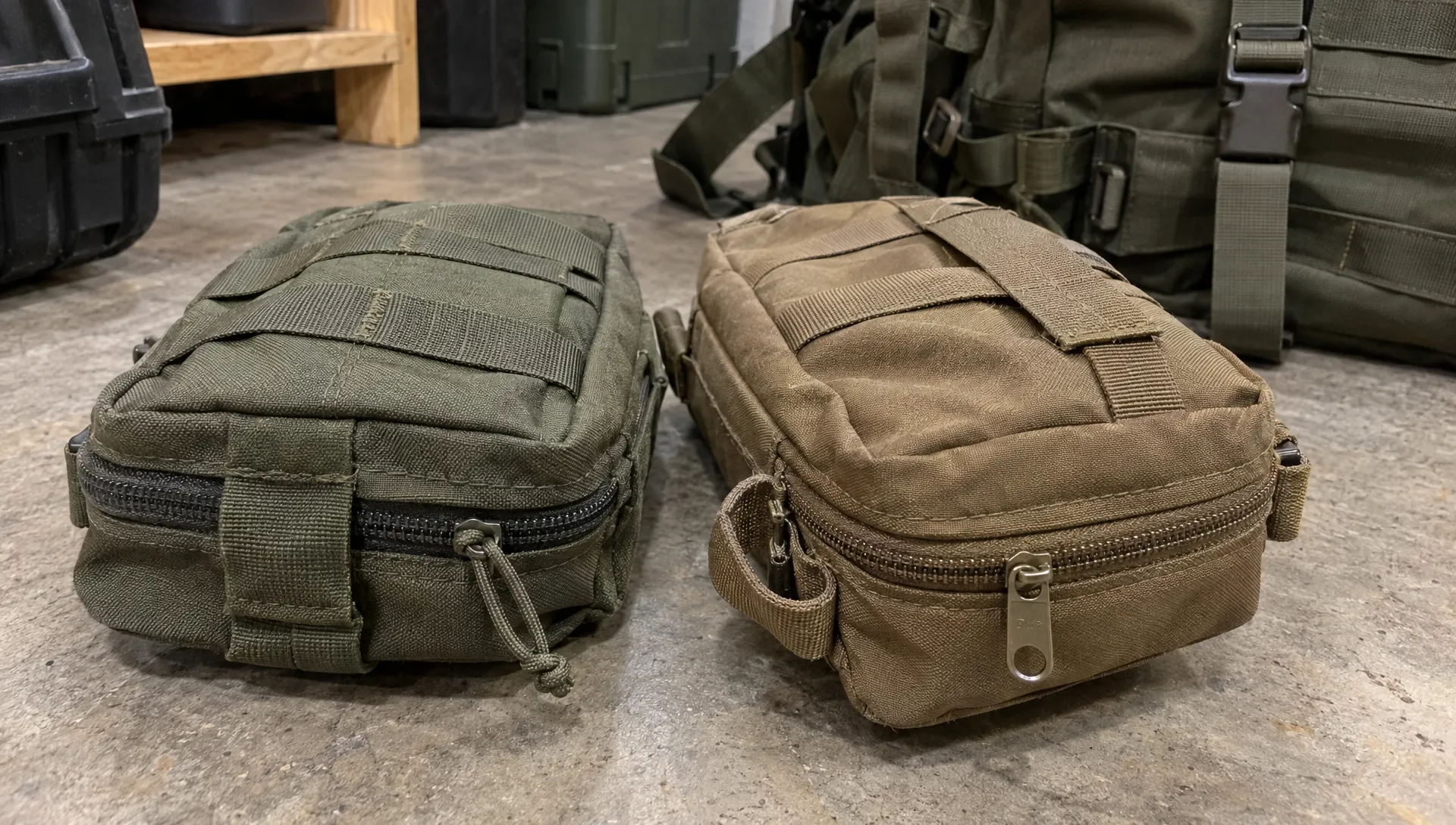
Test the complete assembly, not just the loose pull
A pull can feel quiet in your hand yet knock against equipment once installed. Compare the original and proposed assemblies on the same bag, with the same load and the same neighboring hardware secured.
Repeatable checks are more useful than an unsupported “silent” claim. Start in a quiet room, then test under the conditions relevant to your gear. Keep the movements consistent so you are comparing the assembly rather than changing the test each time.
A practical comparison routine
- Movement noise: Walk, bend and set the loaded bag down, listening for contact between the pull, slider and nearby hardware.
- Glove access: Open and close the compartment repeatedly with the gloves you actually use, including access beneath any flap.
- Snagging: Check whether the loop catches during ordinary handling or slips around nearby straps and fittings.
- Attachment wear: Look for cord fuzzing, cut fibers, loose stitching, displaced knots or connectors that have started to open.
- Wet handling: Where the gear permits it, check grip and flexibility after dampening, then inspect again after drying.
Evaluate a military zipper pull after repeated use, not only immediately after installation. Soft components can settle, knots can shift and wear may concentrate at a small attachment opening. A sharp or damaged opening should be addressed rather than hidden beneath a thicker cord.
A phone recording can help document an obvious rattle, but automatic microphone processing makes it unsuitable for claiming a precise noise reduction without a controlled measurement method. Record observations such as “metal-on-metal clicking remains during walking” instead of inventing a decibel rating.
For production projects, combine these usability checks with a defined durability plan. HiLabels' guide to strength-testing heavy-duty zipper pulls before production explains why the attachment system deserves attention alongside the visible grip. A zipper pull should not be treated as a lifting point or load-bearing tie-down.
Turn your choice into a clear ordering specification
A useful order description includes the existing slider, attachment opening, finished exposed length, grip construction and intended glove use. Include photographs showing the pull at rest and the neighboring hardware it could strike. Those details communicate more than “heavy-duty black pull.”
For a custom military zipper pull, separate appearance requirements from functional acceptance criteria. Color and branding are one category; secure attachment, glove access and acceptable movement noise are another. If you specify a noise check, describe the load, movements and comparison assembly so another person can repeat it.
Keep branding compact enough that it does not require a larger, stiffer grip than the task needs. Evaluate any raised lettering, seams or molded edges with gloves rather than approving the artwork alone.
Before committing to a production quantity, ask about the available constructions and whether a sample can be evaluated. Confirm that the approved attachment method and dimensions will be reflected in the order, rather than assuming every pull with the same appearance fits identically.
Frequently asked questions
Can a replacement pull fit bags and jackets from another brand? Sometimes. For a pull-only replacement, the attachment geometry and slider mechanism determine compatibility more directly than the garment or bag brand. A complete replacement slider requires a closer match to the zipper system.
Is paracord always the quietest option? No. It can provide a soft gripping surface, but its diameter may be unsuitable for a small opening. A long loop can also snag, and an original metal tab may continue to rattle beneath it.
Does a military zipper pull need a metal core? Not inherently. The appropriate construction depends on the attachment, expected handling and any documented procurement requirements. A metal core is not, by itself, evidence of suitability or compliance.
Are double-pull sliders the same as two sliders? No. A double-pull slider has a pull on each side so it can be operated from either face. A zipper with two sliders has two separate slider bodies. Check the actual configuration because it changes access and possible contact points.
Can any replacement make a zipper completely silent? No universal replacement can guarantee that. A softer, better-fitted pull can reduce rattling, but zipper operation, fabric movement and surrounding hardware still produce sound.
Discuss a pull that fits your gear
For branded bags, jackets or pouches, bring your slider photographs, proposed dimensions and test observations to HiLabels when discussing custom zipper pulls. Ask which available materials and attachment options suit the application. Choose the assembly that demonstrates secure grip, appropriate clearance and reduced rattling on your actual gear, not simply the one with the most rugged appearance.


