How Woven Tag Labels Improve Apparel Branding
A garment can have a beautiful cut, quality fabric, and a strong visual identity, but the branding often becomes tangible in one small place: the tag. Woven tag labels turn a logo or brand name into a lasting detail that shoppers can see, touch, and remember every time they wear the piece.
Unlike temporary packaging, a woven tag stays with the product. It becomes part of the garment experience, from the first try-on to repeated washing, storage, resale, gifting, and everyday use. For apparel brands, designers, makers, and merch teams, that permanence makes woven tag labels one of the most efficient branding tools available.
Why woven tag labels matter in apparel branding
Apparel branding is not only about being recognized on a website or in a social feed. It is about creating continuity between what customers see before purchase and what they experience after purchase. A woven label helps bridge that gap.
When a customer picks up a shirt, hoodie, hat, dress, or handmade item, the tag quietly answers important questions: Who made this? Does it feel professional? Is this brand intentional? Will this product hold up? A well-made woven tag label gives those answers without a sales pitch.
The same principle applies across categories where trust depends on physical details and documentation. In the automotive world, for example, buyers may rely on an official EU-recognised Certificate of Conformity to confirm vehicle information. Apparel is not as regulated in the same way, but the label still acts as a credibility signal. It shows that the product is not generic, improvised, or unfinished.
For emerging apparel brands, this is especially important. Customers may not know your name yet, so every detail has to support confidence. A woven tag label creates a more complete brand experience and helps your product look ready for boutiques, pop-ups, online orders, wholesale accounts, and premium packaging.
What woven tag labels communicate at a glance
Woven labels are created by weaving threads together rather than printing ink on a surface. That construction gives them texture, depth, and durability. The result is a label that feels more integrated with the garment and often looks more premium than a paper hang tag or basic printed tag.
A strong woven tag label can communicate several brand attributes at once:
- Quality: A woven finish suggests attention to detail and craftsmanship.
- Consistency: Repeating the same label style across products helps customers recognize your brand faster.
- Durability: A woven label is designed to remain readable through wear and washing.
- Identity: Color, typography, logo shape, and placement all reinforce brand personality.
- Care: The presence of a clear label makes the product feel considered and complete.
This is why woven tags are used by everyone from independent makers to established fashion labels. They work quietly, but they work often. Each time the customer folds the garment, checks the size, hangs it up, or receives a compliment, the brand has another chance to be noticed.
How woven tag labels support different brand positions
Not every apparel brand needs the same label strategy. A minimalist luxury line, a streetwear brand, a children’s clothing company, and a handmade accessories shop all have different messages to communicate. Woven tag labels are flexible enough to support each of these directions.
For premium brands, a clean woven label with restrained colors can reinforce elegance. For lifestyle or streetwear brands, a bold hem tag or exterior label can become part of the design itself. For handmade brands, a soft woven sewing label can make a product feel more professional without losing its personal character. For workwear, uniforms, bags, and outdoor products, a durable woven patch may create stronger visibility than an interior tag.
The goal is not simply to place your logo somewhere. The goal is to match the label to the product’s role in your customer’s life. A subtle neck label may be best for a soft T-shirt, while an exterior side-seam tag may suit a hoodie or tote. If you are building a consistent product line, it can help to think of labels as a brand system rather than one isolated design.
HiLabels explores this idea further in its guide to how custom woven labels make your brand memorable, especially when the same identity is repeated across multiple products and customer touchpoints.
Woven tag labels vs other apparel branding options
Woven tags are not the only way to brand apparel. Printed neck labels, heat transfers, embroidery, patches, hang tags, packaging inserts, and care labels can all play a role. The best choice depends on the garment, price point, comfort needs, and visual style.
The key difference is permanence. Hang tags are removed. Packaging is discarded. Social media posts disappear in a feed. A woven tag remains attached to the garment, which means it continues to represent your brand long after the transaction.
| Branding option | Best use | Main advantage | Limitation |
|---|---|---|---|
| Woven tag labels | Apparel, accessories, handmade goods, premium product lines | Durable, tactile, and integrated with the product | Very tiny details may need simplification |
| Printed labels | Basic sizing, care information, lightweight garments | Smooth feel and cost-effective for simple information | Can fade depending on process and use |
| Hang tags | Retail storytelling, pricing, launch messaging | Great for first impressions and product details | Removed after purchase |
| Woven patches | Outerwear, hats, bags, workwear, statement branding | High visibility and strong design presence | May not suit every garment style |
| Care labels | Fiber content, washing instructions, compliance support | Practical and expected by customers | Usually less brand-forward than a main label |
A complete apparel brand may use several of these together. For example, a T-shirt might have a woven neck label, a printed care label, and a hang tag for retail display. A cap might use a woven patch on the front and a small interior label for brand identification.
Design choices that make woven labels feel premium
The quality of a woven tag label is not only about production. It starts with design decisions. A label with too much text, weak contrast, or tiny decorative details can look crowded. A simpler layout often feels more confident and more expensive.
Start with the most important identity elements. For many brands, that means the logo, wordmark, or short brand name. If your logo has very fine lines, gradients, small icons, or complex lettering, it may need to be adapted for weaving. This is not a downgrade. It is part of translating a digital logo into a tactile product detail.
Color matters as well. High contrast improves readability, especially on small tags. A black label with white thread, cream label with dark thread, or tonal label with subtle contrast can all work, depending on the brand mood. If your collection uses a signature palette, woven labels are a good place to reinforce it.
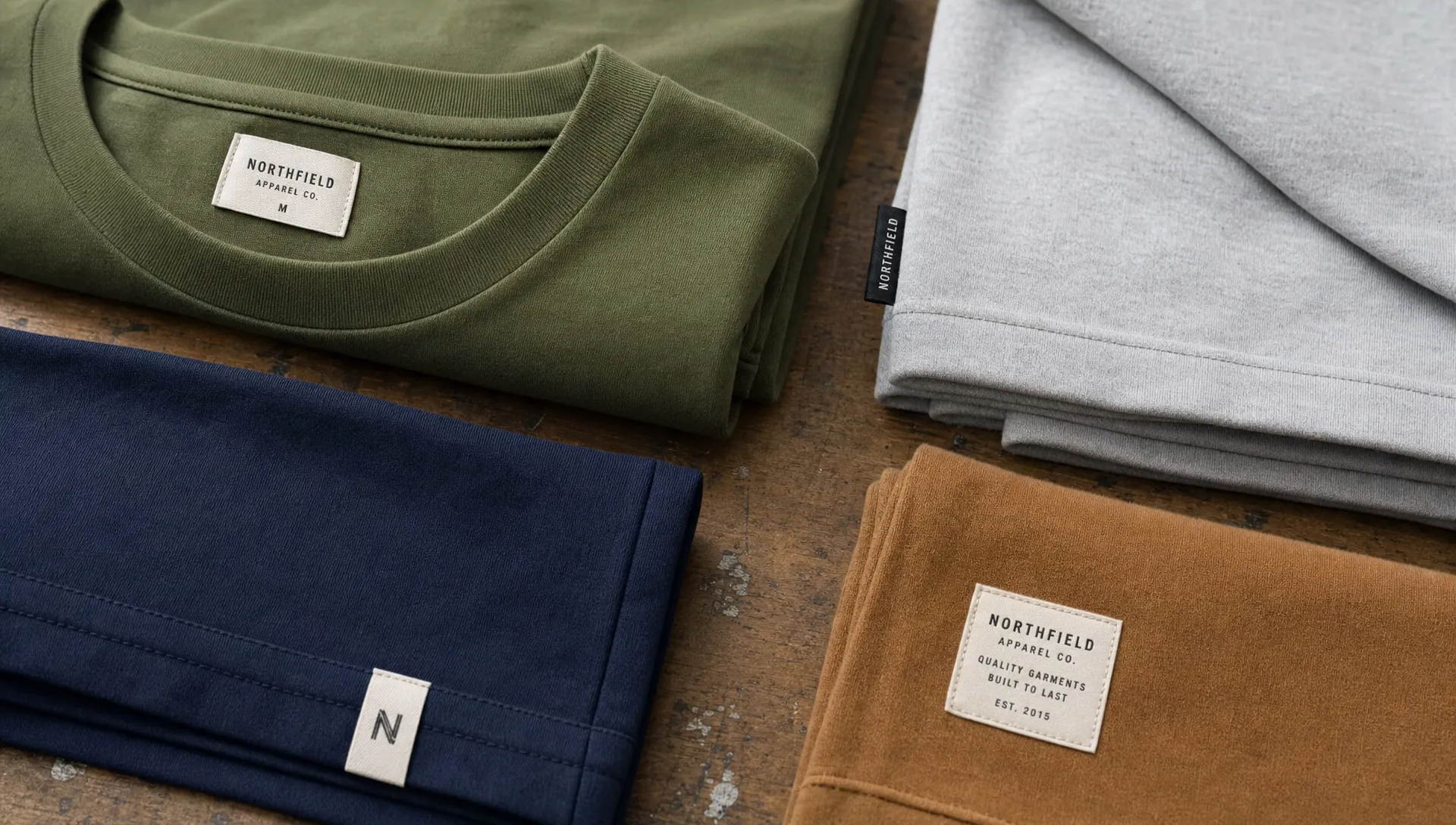
Placement also changes the message. A center-fold neck label feels classic and functional. A side-seam label feels modern and subtle. A hem tag makes branding visible from the outside. A patch can become a design feature rather than a hidden detail. If you are unsure which construction fits your garment, HiLabels has a helpful guide on what makes a great woven clothing tag, including readability, comfort, fold style, and artwork considerations.
How woven tags improve the customer experience
Branding is not only visual. It is experiential. A scratchy, bulky, or poorly placed tag can frustrate customers, even if the garment itself is well made. A soft, appropriately sized woven label improves the finished feel of the product and reduces the sense that branding was added as an afterthought.
Comfort is particularly important for neck labels, children’s clothing, activewear, sleepwear, and base layers. In these categories, the best label is often one that communicates the brand clearly while staying soft and unobtrusive. For outerwear, bags, denim, and hats, brands may have more freedom to use thicker, more visible woven details.
Woven tag labels also support customer confidence by making product information easier to identify. A buyer can quickly confirm size, brand, and care details. This is useful in retail environments, but it is also valuable at home, where customers may return to the label before washing or storing the garment.
That repeated interaction is where brand equity builds. A customer may forget the packaging, but they are likely to see the label again and again. Over time, that small detail contributes to familiarity.
Why woven labels help products look retail-ready
Retail buyers, boutique owners, and customers all notice finishing details. A garment without a professional tag can feel incomplete, even when the material and construction are strong. Woven tag labels help transform an item from a blank product into a branded product.
This matters for small brands that are moving from hobby sales to wholesale, or from local markets to e-commerce. A consistent woven label can make a collection feel more organized. It also makes inventory easier to identify, supports product photography, and gives customers a stronger sense that they are buying from a real brand rather than a one-off seller.
For apparel companies selling online, the label may appear in close-up product photos, unboxing videos, customer reviews, and user-generated content. Even if it is not the focus of the image, it reinforces authenticity. A visible hem tag, for example, can make a basic garment look more finished and recognizable. HiLabels explains this in more detail in its article on why woven hem tags make apparel look more finished.
Common mistakes to avoid when ordering woven tag labels
A woven label is a small format, so precision matters. Most mistakes come from trying to include too much or choosing a style that does not match the garment.
Avoid these common issues:
- Overloading the design: Small labels work best with simplified artwork and clear priorities.
- Ignoring contrast: Low-contrast thread combinations can make the logo difficult to read.
- Choosing the wrong size: A label that is too large may feel awkward, while one that is too small may lose detail.
- Forgetting comfort: Neck labels and children’s garments need special attention to softness and placement.
- Using inconsistent branding: Different fonts, colors, and logo versions across products can weaken recognition.
- Waiting until the last minute: Labels should be planned early so sampling, sewing, and packaging stay on schedule.
The strongest woven labels are designed with the garment in mind. A label for a structured jacket does not need to behave like a label for a soft baby bodysuit. A label for a premium capsule collection may need a different finish than one for promotional merchandise.
How to plan woven tag labels for your apparel line
Before ordering, define the role of the label. Is it mainly for brand recognition, product information, exterior decoration, sizing, care instructions, or a mix of these? Once the purpose is clear, it becomes easier to choose the right format.
A practical planning process usually includes a few simple decisions. Choose the garment category, decide where the label will be sewn, simplify the artwork, select colors, confirm dimensions, and review how the label will feel against the fabric. If the label will be used across many products, think about whether it can scale from T-shirts to hoodies, hats, bags, or accessories.
HiLabels supports brands with custom woven labels, care labels, patches, ribbons, zipper pulls, and bespoke product options. The online label creation process and artwork upload option can help you move from idea to production more efficiently, while personalized customer service is useful when you need guidance on label type, size, or finish. With decades of experience and European loom quality, the focus is on creating durable branding products that look polished on finished garments.
Frequently Asked Questions
What are woven tag labels? Woven tag labels are fabric labels made by weaving threads together to create a logo, brand name, size, or other information. They are commonly sewn into apparel, accessories, handmade goods, and branded merchandise.
How do woven tag labels improve apparel branding? They make the brand feel more professional, consistent, and memorable. Because they stay attached to the garment, they continue reinforcing brand identity long after the customer has removed packaging or hang tags.
Are woven labels better than printed labels? Woven labels often feel more premium and durable, while printed labels can be useful for very detailed information or a smooth tagless feel. Many apparel brands use both, depending on the product and placement.
Where should a woven tag label be placed? Common placements include the inside neck, side seam, hem, sleeve, waistband, pocket, or exterior patch area. The best choice depends on whether the label should be subtle, functional, or visible as part of the design.
Can small brands use woven labels? Yes. Woven tag labels are especially valuable for small apparel brands because they help products look finished, consistent, and retail-ready without requiring a complete packaging redesign.
Build a stronger brand into every garment
Woven tag labels may be small, but they carry a lot of branding weight. They help customers recognize your apparel, trust the quality, remember your name, and experience your product as complete.
If you are ready to create labels that match your brand and your garments, explore HiLabels for custom woven labels, patches, care labels, ribbons, zipper pulls, and other professional branding details designed to make apparel look finished from the inside out.


