Leather Zipper Pulls: Choosing the Right Style for Bags
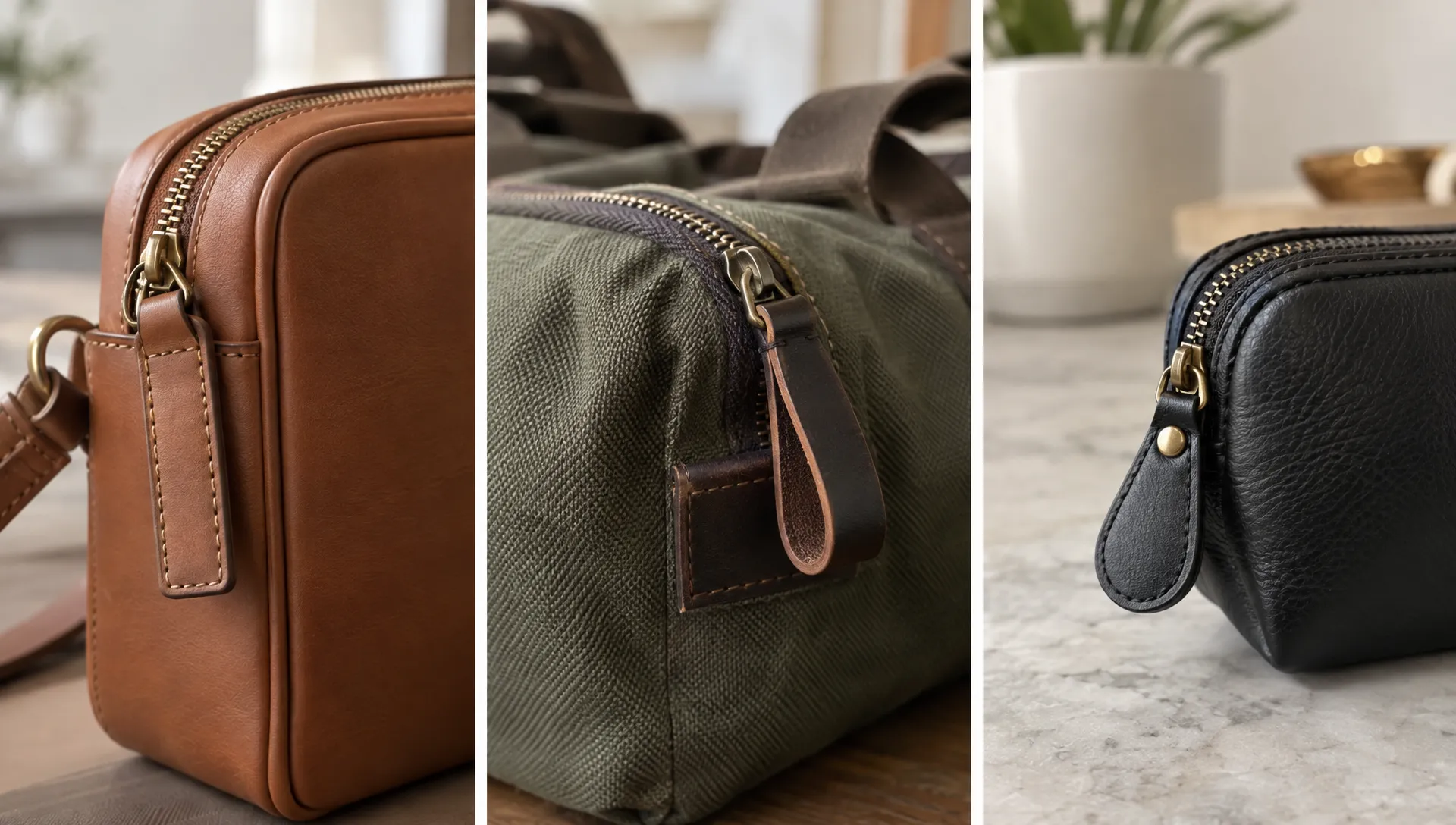
A leather zipper pull can make a bag feel more considered, but the right choice involves more than matching its color to the handles. Shape, flexibility, edge finish and attachment all affect how the detail looks and works. A slim tab may suit a structured crossbody, while a broader loop can be easier to grasp on a roomy weekender.
For bag designers, independent brands and makers, the goal is to choose a pull that belongs on the product. This guide focuses on selecting a style for a new bag or collection, from the first design brief to the sample checks that help prevent an attractive detail from becoming an everyday annoyance.
Start with the bag’s purpose
Before choosing a shape, decide what the pull needs to do. A main compartment opened throughout the day needs an easy grip. An interior pocket may need only a discreet tab that stays out of the way. A decorative accent on an occasion bag has different demands from a pull on a travel duffel.
Consider the conditions of use, too. A commuter bag may encounter rain, hand lotion and repeated contact with clothing. A small evening bag may see less abrasion but needs a compact detail that does not distract from the silhouette.
The right leather zipper pull should support the bag’s intended use rather than simply repeat a detail from another product.
Define three priorities before sampling: the visual role, the grip requirement and the attachment method. Treat those as your selection criteria. If your design needs a pronounced decorative accent, the principles in HiLabels’ guide to decorative zipper pulls that balance style and use can help you assess the trade-off between appearance and practicality.
Choose a leather zipper pull style that suits the silhouette
Shape changes the visual weight of a pull. It also determines how fingers find and hold it, especially when the bag is full or the zipper sits close to a seam.
| Style | Design character | Often suits | What to check |
|---|---|---|---|
| Flat rectangular tab | Clean and understated | Structured totes, crossbodies and pouches | Whether the tab is easy to pinch |
| Folded loop | Relaxed and dimensional | Weekend bags and casual shoulder bags | Whether the loop catches on nearby hardware |
| Tapered tab | A narrower, shaped profile | Compact bags and refined accessories | Whether the narrow end remains comfortable to grip |
| Short rounded tab | Soft and unobtrusive | Small pockets and curved bag designs | Whether enough material remains exposed |
| Leather tassel | Decorative with noticeable movement | Statement handbags and bohemian styles | Whether the strands crowd the opening or snag |
These are starting points, not rules. A folded loop can work on a polished bag if its proportions and finish are restrained. A flat tab can feel casual when made from textured leather with visible stitching.
Evaluate a leather zipper pull against the whole bag, not as an isolated accessory. Look at it beside the handle attachments, zipper tape and other hardware. If the bag already has several prominent details, a quieter pull may create a more coherent result.
Compare leather construction and finish
Grain, surface treatment and flexibility
Full-grain leather retains the grain surface without corrective sanding, while top-grain leather may have surface correction and finishing. Split leather comes from a lower layer of the hide. These descriptions help identify the material, but they do not establish how a finished pull will perform by themselves.
Thickness, tanning, surface coating and construction also matter. A substantial piece of leather can feel reassuring yet be too stiff for a small zipper. A softer leather may feel comfortable but need reinforcement around its attachment point.
Smooth finishes create a more uniform appearance. Pebbled textures can make minor surface marks less conspicuous. Suede offers a softer look, although its nap can change with handling and requires different care from smooth finished leather.
Edges and reverse surfaces
Inspect the back as carefully as the front. A pull may twist during use, exposing unfinished fibers or a reverse color that was not considered in the design.
A leather zipper pull should be assessed as a complete component, including its edges, reverse surface and attachment area. Ask whether the edges will be left raw, burnished, painted or folded and stitched. Each treatment creates a different appearance, and its suitability depends on the leather and intended use.
Do not assume a material described as “genuine leather” has a particular grade or finish. Request a clear material specification and inspect a physical sample.
Set proportions around grip and clearance
A leather zipper pull needs enough exposed material for a comfortable grip without hanging so far that it interferes with the bag. Measure the usable portion beyond the attachment, not just the total length of the leather piece.
For a medium everyday bag, an exposed tab around 35 to 50 mm long and 10 to 15 mm wide can be a useful prototype range. These are design starting points, not universal specifications. Small interior pockets may need less material, while a larger travel bag may benefit from a more substantial grip.
Thickness is equally important. A thick tab can become awkward where it folds through a small opening. A thin strip may fold neatly but offer less body when pinched. Ask the supplier to confirm the finished thickness rather than relying on a photograph.
Check clearance with the zipper both open and closed. The pull should not become trapped beneath a flap, strike adjacent hardware or drag across a delicate panel. On a bag with two sliders, test whether the pulls overlap comfortably when they meet.
For users who need a larger gripping area, HiLabels’ guide to zipper pull extensions that improve grip offers a useful functional perspective. The attachment must remain compatible with the zipper even when the gripping surface gets larger.
Match the attachment to the actual zipper
The zipper slider is the component that moves along the chain. Its existing pull tab provides the gripping and attachment point. A leather extension can connect to that tab, but it does not replace a damaged slider or correct a zipper that separates.
Inspect the opening where the leather or connector will attach. A zipper’s chain size alone does not tell you whether a particular loop, ring or leather strip will fit.
Direct leather loops
A narrow strip can pass through an existing opening and secure through its own slot or another designed fastening. This can keep the assembly visually simple, but the opening must accommodate the folded leather without forcing it against sharp edges.
Rings and other connectors
A connector can give a wider tab more freedom to move. It also introduces another component that must suit the hardware finish and remain securely closed. A rivet or stitched fold may secure the leather around that connector, depending on the construction.
Before approving a leather zipper pull, check that its attachment lets the original pull tab move normally. Some sliders use a locking mechanism operated through the tab, so an added detail must not obstruct that movement. Avoid bending or prying original hardware unless the zipper manufacturer specifies that it is designed for that operation.
Coordinate color and branding without overloading the detail
Matching the bag’s leather exactly can create a unified appearance, but coordination does not always require an identical color. A darker pull may connect visually with the handles. A contrasting tab can help users locate the opening, particularly against dark zipper tape.
Compare samples beside the actual bag materials under more than one lighting condition. Black leather, for example, can vary in undertone and sheen. Hardware described as brass or silver may also differ in color and surface finish between suppliers.
For branding, allow the available surface to guide the artwork. A short wordmark or simple symbol is generally easier to resolve on a small tab than a detailed logo. Debossing presses the design into the surface, while embossing produces a raised effect. Other marking methods may be available, but suitability depends on the leather and supplier.
Keep the branded area away from punched holes, tight folds and heavily flexed sections where possible. Do not assume a logo that works on a large label will reproduce equally well on a narrow leather component.
A branded leather zipper pull should look intentional even when the logo is not immediately readable. Shape, color and finish can provide recognition without making the component larger than the bag needs.
Approve a working sample, not just a photograph
A photograph can confirm the general shape and color. It cannot establish grip comfort, attachment security or how the leather behaves during repeated opening.
Test the sample on the intended zipper and bag construction. Load the bag as a customer reasonably would, then open it from different positions. Use the pull with dry hands and, if relevant to the product, while wearing gloves. Check for twisting, slipping and contact with neighboring details.
For a production brief, record the details that affect repeatability:
- Material: Leather type, finish, thickness and reverse-surface treatment.
- Dimensions: Overall size, exposed gripping length and attachment-hole or slot size.
- Construction: Edge treatment, stitching, folds and reinforcement.
- Attachment: Connector type, opening dimensions and hardware finish.
- Branding: Artwork size, placement and proposed marking method.
- Sample checks: Grip, clearance, flexing, attachment security and color transfer.
Ask the supplier how colorfastness should be evaluated for the proposed leather. Dye transfer can matter when a dark pull contacts a light bag lining or clothing. If wet handling is part of the intended use, agree on an appropriate sample test rather than assuming the finish is water-resistant.
Approve the material and construction together. Changing leather thickness or coating after approval can alter the fit, flexibility and appearance of the finished component.
Frequently asked questions
Is a leather zipper pull suitable for a travel backpack? It can be, provided the grip, attachment and finish suit frequent use. For a backpack exposed to regular rain, mud or demanding outdoor conditions, compare leather with materials chosen specifically for that environment. Leather alone does not imply weather resistance.
Should the pull match the bag’s handles? Matching is one option, but a coordinated contrast can work just as well. Compare undertone, texture and sheen rather than color alone, then check whether the pull supports the bag’s overall design.
Can a leather tab attach to any zipper? No. Compatibility depends on the available opening, the connector and the movement of the existing pull tab. Test it on the actual zipper rather than selecting by chain size or appearance alone.
Does leather need conditioning? Care depends on the leather and its finish. Follow the supplier’s instructions, and test any recommended product on a spare sample first. Oils or conditioners can darken some leathers or affect coatings, adhesives and edge treatments.
Bring a clear brief to your zipper pull project
Once you have selected the shape, material and attachment approach, prepare your dimensions and artwork for supplier review. HiLabels offers custom zipper pulls and other branding products for bags and apparel. Discuss your requirements with the team and confirm available materials, construction options and customization methods before ordering.


