Plastic Zipper Slider vs Metal for Lightweight Products
Choosing a plastic zipper slider instead of metal can reduce hardware weight, but it is not automatically the best choice for every lightweight product. A packable jacket, a cosmetic pouch and a daily-use backpack place different demands on the same small component. The right decision depends on zipper compatibility, operating force, loading and the conditions the finished product will face.
For designers and sourcing teams, the useful comparison is not simply plastic versus metal. It is two compatible zipper assemblies tested on the actual product, including their pull tabs, locking mechanisms and attachment details.
First, distinguish the slider from the zipper teeth
The slider is the moving body that brings the zipper elements together or separates them. The pull tab is the part the user grips. If your specification uses these terms interchangeably, this guide to the difference between a zipper slider and a puller can help clarify the component you are selecting.
A zipper described as “plastic” may have molded plastic teeth or a synthetic coil, yet still use a metal slider. Plastic teeth do not establish the slider’s material. Ask the supplier to identify the body material separately from the chain and pull tab.
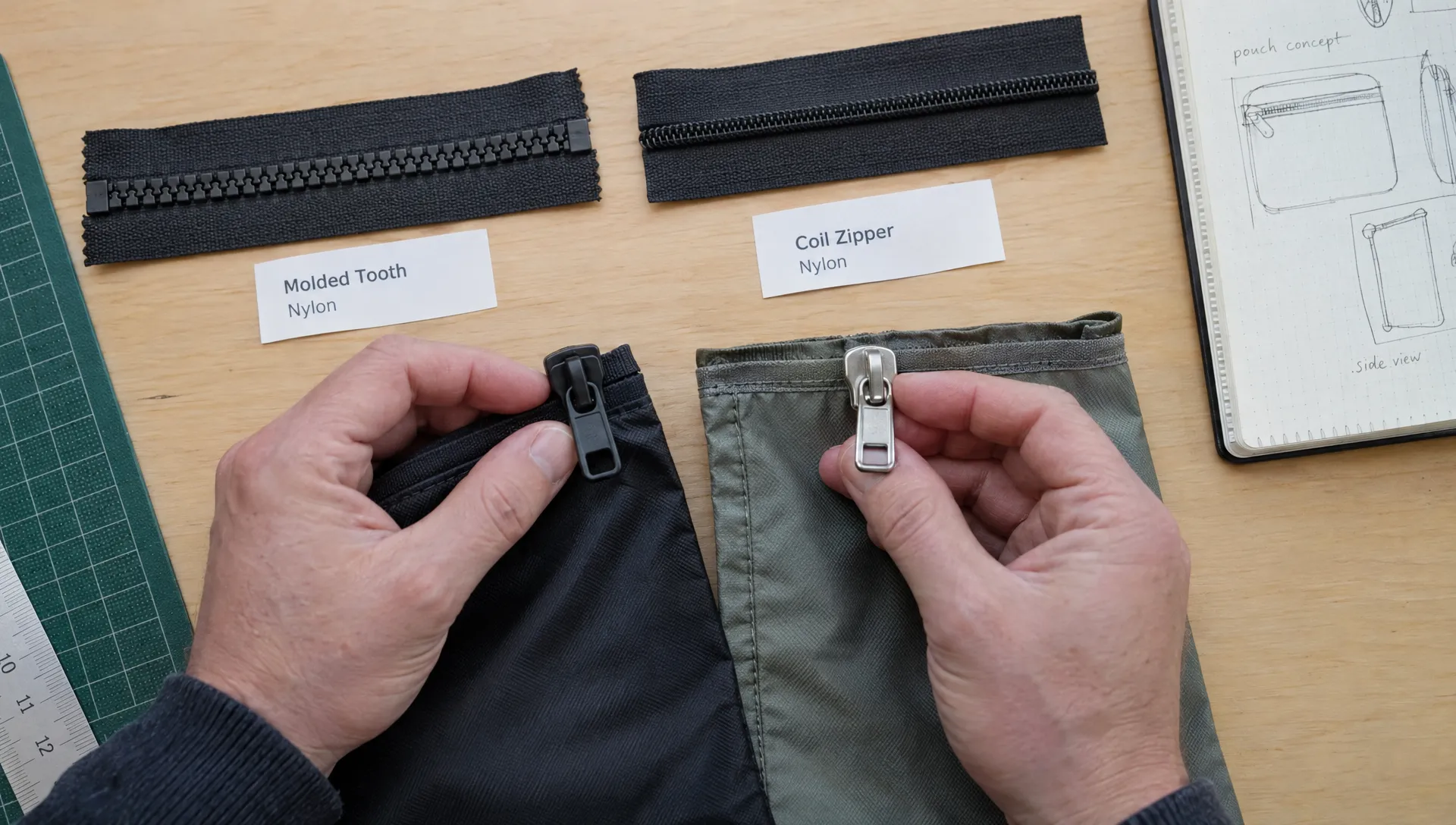
The main chain constructions are straightforward to recognize:
- Molded teeth: Separate, visibly shaped plastic elements attached along the tape.
- Coil: A continuous synthetic coil, sometimes positioned toward the inside on a reverse-coil zipper.
- Metal teeth: Individual metal elements attached along the tape.
Before choosing a plastic zipper slider, confirm that the supplier offers one for the exact chain construction and series you intend to use. A similar appearance or matching size number is not enough.
Plastic zipper slider vs metal: the practical trade-offs
Polymer sliders may use engineering plastics such as acetal, while metal sliders commonly use zinc alloy. Other materials and constructions exist, so request the actual material specification rather than relying on a catalog category.
| Selection factor | Plastic slider body | Metal slider body |
|---|---|---|
| Weight | Can reduce weight in a comparable design | Often heavier, but material and geometry matter |
| Load resistance | Depends on resin, reinforcement and body design | Depends on alloy, wall thickness and body design |
| Sustained loading | Evaluate deformation and creep | Evaluate spreading, bending and permanent deformation |
| Environmental exposure | Check temperature, UV and chemical compatibility | Check base metal, finish and corrosion resistance |
| Surface finish | Color may be incorporated into the material | Plating, paint or other finishes may be available |
| Compatibility | Must match the specified zipper system | Must match the specified zipper system |
A plastic zipper slider can be a useful weight-saving option when its operating limits fit the application. It is not a substitute for verifying strength, and metal is not a guarantee of durability.
Weigh the complete assembly, not just the slider body. A large decorative pull or an added cord attachment can offset savings elsewhere. Compare samples with equivalent functions, chain sizes and pull lengths so that the result reflects material selection rather than unrelated design changes.
Cost also needs a finished specification. Material alone does not determine price; tooling, order quantity, finish, assembly and testing requirements can change the comparison.
Match the material to how the product is used
Packable apparel and low-load pouches
For an organizer pocket, packing pouch or lightweight garment pocket, low mass and easy operation may matter more than resistance to high loads. A polymer body is worth evaluating when the zipper follows a gentle path and users are unlikely to force an overfilled compartment shut.
Use a plastic zipper slider only after checking how the complete zipper behaves in the intended fabric. A light shell can wrinkle or enter the slider throat if the installation leaves too little clearance. Changing the slider material will not fix poorly supported tape or an obstructed zipper path.
On apparel, also check whether the zipper must stay at a selected position. An appropriate locking mechanism may matter more to usability than a small difference in weight.
Lightweight bags with demanding daily use
A bag can weigh very little while its closure experiences substantial stress. Overpacking, pulling around tight corners and opening a compartment with one hand can load the slider unevenly.
Metal may be the better candidate when the selected assembly offers a stronger, better-supported design for those conditions. However, do not choose a metal body merely because it feels substantial. An undersized or incompatible metal slider can still wear, spread or separate the chain.
Start by reviewing the zipper path and capacity. Increasing a corner radius, reducing fabric interference or choosing a more suitable chain size may improve performance more than changing the body material alone.
Products exposed to salt, heat or outdoor storage
A plastic zipper slider avoids corrosion of the polymer body itself, which can be useful around moisture or salt. That does not make the entire assembly corrosion-free: a spring, pull tab or other component may still contain metal.
For polymer parts, ask about the actual resin’s temperature range, UV resistance and compatibility with expected cleaners, sunscreen or insect repellent. Properties vary by formulation. Cold-weather impact performance and deformation under sustained load also deserve attention where relevant.
For metal parts, evaluate the alloy and protective finish together. Scratches, salt exposure and repeated abrasion can affect performance or appearance. Neither material should be labeled “outdoor-ready” without evidence for the intended conditions.
Treat compatibility as a requirement, not a preference
A plastic zipper slider is not a universal replacement for a metal one, even when both carry the same nominal size marking. Slider channels must suit the element shape, dimensions and orientation of the chain.
Record the zipper manufacturer and series whenever possible. Then confirm the chain type, nominal size, slider direction and locking function. Reverse-coil and conventional coil configurations should not be treated as interchangeable without supplier confirmation.
Use calipers to record the width of the closed chain across the elements, excluding the fabric tape. This is useful identification information, but it is not a universal sizing formula. A size number should not be interpreted as an exact millimeter measurement or proof of cross-brand compatibility.
Also distinguish between an auto-lock function, which helps resist unintended movement, and hardware designed to accept a luggage lock. These solve different problems.
For development, obtain the slider and chain as a supplier-confirmed combination. If you are evaluating an alternative supplier, provide a physical zipper sample where possible. Photos and measurements help, but they cannot establish every internal fit requirement.
Validate the complete assembly before production
A smooth first opening is not enough to approve hardware. Test samples sewn into the production fabric with the intended seam allowance, lining, zipper guards and pull attachment. Loose zipper samples can miss problems caused by the finished construction.
Build the evaluation around realistic use rather than an arbitrary “heavy-duty” label:
- Measure mass and operating force: Compare complete assemblies and check effort along the full zipper path.
- Cycle the closure: Look for increasing resistance, looseness, surface wear or chain separation over repeated operation.
- Apply representative loads: Include normal filling, foreseeable overfilling and off-axis pulling where relevant.
- Expose and retest: Use the washing, moisture, temperature or chemical conditions appropriate to the product.
- Inspect the whole system: Examine the slider body, pull attachment, chain, stops, tape and seams.
Ask a supplier or testing laboratory which methods fit your requirements. ASTM D2061 covers strength tests for zippers, while ASTM D2062 addresses operability. Naming a standard alone does not establish a pass result; agree on the relevant procedure, conditions and acceptance criteria.
Approve a plastic zipper slider against the same functional requirements as its metal alternative, rather than giving it a lower durability target because it weighs less. Keep approved reference samples and record the component specification so production substitutions do not quietly change performance.
Keep branding from undoing the weight savings
A custom pull can make a small zipper easier to find and use, especially on a pocket or compact pouch. Its dimensions, edge shape and attachment method should support that function before decoration is added.
If a plastic zipper slider meets your weight target, pairing it with an oversized metal pull may undermine the reason for choosing it. Conversely, a compact metal slider with a lightweight pull may produce a better overall balance than a larger polymer assembly. Measure both configurations instead of assuming which will be lighter.
Test grip with the intended user and conditions. A tiny tab may save weight but be frustrating with gloves or wet hands. An excessively long pull can snag or apply unwanted leverage to the attachment point.
When developing custom zipper hardware for branded bags and apparel, keep the approved slider interface fixed while evaluating branding options. A new pull design still needs checks for clearance, attachment strength and any interaction with the locking mechanism.
Frequently asked questions
Is plastic always lighter than metal? No. Weight depends on material, dimensions and construction. Compare complete, functionally equivalent assemblies, including the pull tab and any attachment hardware.
Can a plastic zipper slider replace a metal slider on an existing zipper? Only if it is confirmed compatible with that exact zipper system. Matching the nominal size number does not establish compatibility, and some chains may not have a suitable polymer option.
Does changing the pull tab change the slider material? No. The pull tab and slider body are separate components. Replacing a metal pull with a cord or fabric pull can change weight and grip without changing the body that operates the zipper.
Will a replacement slider fix a zipper that separates? Sometimes, if the slider is worn and the chain remains intact. Missing or distorted elements, damaged coil and torn tape may require replacing more of the zipper. Inspect the chain before specifying a replacement.
Plan the pull around the approved zipper
Choose the compatible zipper assembly first, then finalize its branding. For a custom zipper pull project, share your approved slider sample, attachment details, target weight and intended use with HiLabels. That gives the customization discussion a practical starting point without treating the pull and slider body as interchangeable.


