What Affects the Price of Custom Embroidered Clothing Tags?
The price of custom embroidered clothing tags depends on more than how many pieces you order. Finished size, stitch coverage, artwork preparation, backing, edge treatment and delivery requirements all affect the quote. A low per-piece price can also hide costs for samples, shipping or attachment to your garments.
For a useful comparison, ask suppliers to price the same construction and separate one-time charges from recurring production costs. That lets you see which design choices increase the bill and where you can save without weakening your branding.
Start by confirming what kind of tag you need
An embroidered tag is generally made by stitching a design onto a fabric base. A woven label creates the design through the weave itself. Both use thread, but their production methods and finished appearance differ.
That distinction matters when requesting prices. A quote for a small woven neck label is not directly comparable to a quote for an embroidered patch with a finished border and adhesive backing.
Embroidery works well when raised texture is part of the intended look. Woven construction is often better suited to compact lettering and fine detail. Before discussing cost, confirm whether you need a sewn-in label, an exterior brand badge or a patch-style tag. Our guide to when embroidered brand labels make sense can help you settle that construction decision.
How are custom embroidered clothing tags priced?
A useful quote separates initial preparation, production and delivery. Some suppliers bundle these costs into the unit price, while others list them individually. Neither format is automatically cheaper.
| Cost component | What can affect it | What to clarify |
|---|---|---|
| Artwork preparation | Digitizing, cleanup and design revisions | Which services and revisions are included? |
| Embroidery production | Dimensions, stitch count, coverage and thread requirements | What construction does the quoted price cover? |
| Materials and finishing | Base fabric, backing, border and cutting method | Are all requested finishes included? |
| Sampling | Digital proof, physical sample and sample shipment | What exactly will you receive? |
| Order quantity | Batch size and number of separate versions | Is the quantity priced per design or across the order? |
| Delivery | Production timing, shipping method and destination | Are freight, taxes and applicable duties included? |
The most useful number is not necessarily the cheapest quoted piece. It is the total cost of getting suitable, usable tags onto your garments.
Size and stitched coverage
Larger tags generally require more material, but dimensions alone do not determine embroidery cost. A small design with dense stitching can take more production work than a larger design with substantial exposed fabric.
For custom embroidered clothing tags, ask whether the quote assumes partial coverage or a fully stitched background. If the base fabric already provides the background color you want, leaving it visible may reduce stitching without changing the logo itself.
Send finished dimensions rather than a vague description such as “small chest tag.” Include any space needed for sewing around the design. Shrinking the overall size too aggressively can crowd lettering or leave insufficient attachment space, creating a saving on the tag that causes problems during garment assembly.
Artwork preparation and embroidery digitizing
A logo file usually needs to be converted into embroidery instructions through a process called digitizing. Those instructions determine stitch placement, direction, density and sequencing. A clean vector file helps communicate the design, but it is not automatically a production-ready embroidery file.
Fine lettering, gradients, tiny gaps and intricate outlines may need simplification. More thread colors can also affect production, although stitch count and machine setup may matter more than color count alone. Ask how the supplier prices your actual design rather than assuming each additional color carries a fixed surcharge.
Artwork changes can alter the price of custom embroidered clothing tags even when the finished dimensions stay the same. Before approving setup, ask which revisions are included, whether the digitized file can be reused and what happens if you change the size on a later order.
Base fabric, backing and edge finish
The base fabric contributes to appearance, stability and feel. A standard fabric and color may be more economical than a specially sourced material, but the correct choice depends on the garment and placement.
Backing and border treatments add separate considerations. A sew-on tag, a heat-applied badge and a removable patch do not require the same construction. Adhesive backing may add cost, and it should not be assumed suitable for every garment or laundering routine.
Compare edge finishes as part of the complete specification. An overlocked border, a stitched outline and a suitable cut edge can have different costs and appearances. Do not remove a functional finish simply to reduce the quote: exposed edges, excess stiffness or an unsuitable backing can make the finished tag harder to use.
Quantity, design variants and repeat orders
Larger batches often spread setup work across more pieces, reducing the unit price. The savings are not necessarily proportional, so request quotes at quantities you could realistically use.
The price of custom embroidered clothing tags also depends on how the order is divided. One design ordered in a single batch may price differently from the same total quantity split across several logos, sizes or colorways. Ask whether each version has its own minimum quantity or preparation charge.
Repeat orders may avoid some artwork preparation if the supplier retains a usable production file. They still involve manufacturing and order handling, so confirm which charges actually disappear.
Finally, consider inventory risk. A lower unit price does not help if a large share of the order becomes obsolete after a logo change. Compare the savings with your expected garment production before committing to a larger batch.
Budget beyond the supplier’s unit price
A tag is not finished branding until it is attached correctly. Sewing, positioning, thread trimming and inspection can all contribute to the cost per garment. An unusual shape or difficult placement may add handling time even if the tag itself is inexpensive.
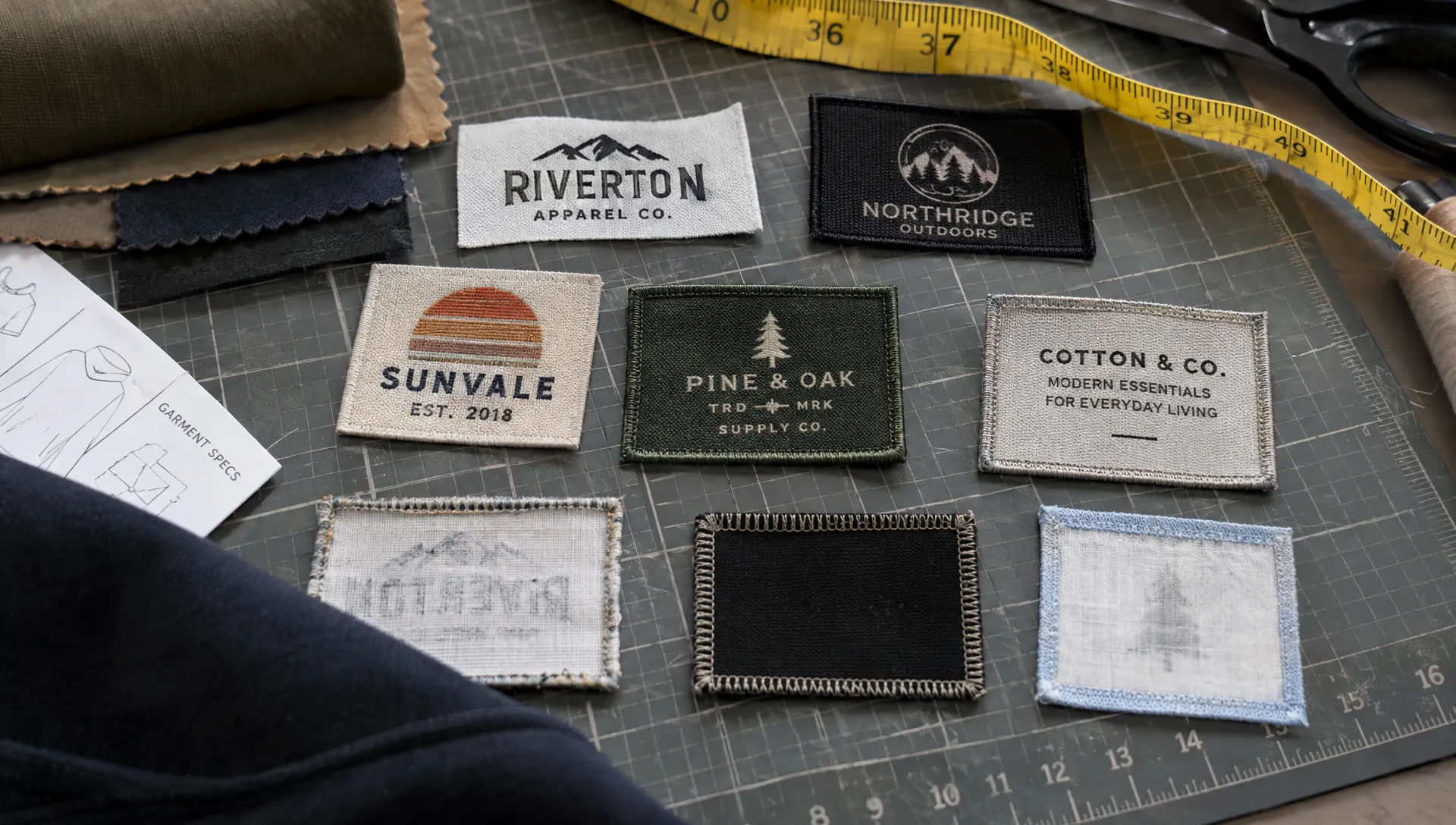
Sampling also deserves a separate budget line. A digital proof can confirm layout, spelling and proportions, but it cannot demonstrate thickness, reverse-side texture or how the tag behaves when sewn onto your fabric. For skin-contact placements, reviewing the comfort factors of embroidered clothing labels can help you decide what to test.
Production speed is another variable. Ask whether the quoted schedule begins after payment, artwork approval or physical sample approval. Standard production followed by expedited shipping is different from rush manufacturing, and either can change the total.
Compare cost per usable tag, not just cost per piece
To compare custom embroidered clothing tags fairly, calculate both the delivered tag cost and the installed cost on the garment.
Delivered cost per usable tag = total tag order cost, including applicable fees and delivery, divided by the number of usable tags.
Then add attachment labor and consumables to estimate the installed cost.
For illustration only, suppose one order costs $240 delivered for 400 usable tags. Its delivered cost is $0.60 per tag. Another costs $330 for 600 usable tags, or $0.55 each. These are hypothetical budgeting figures, not HiLabels prices or market estimates.
The second order has a lower unit cost but requires $90 more upfront. If you only need 400 tags and cannot use the remainder, the larger order may not be the better purchasing decision.
What to include in a quote request
A clear specification reduces back-and-forth and makes supplier comparisons more reliable. Send the same information to every supplier, including an image of the intended placement if it helps explain the application.
- Construction and application: Specify embroidered rather than woven, plus the garment type, placement and intended attachment method.
- Finished dimensions and artwork: Provide width, height, shape, logo files and any required sewing margin.
- Materials and finish: Identify preferred base fabric, thread colors, backing and border, or request recommendations where undecided.
- Quantities and versions: State the count for each design, size or colorway rather than only the combined total.
- Approval and delivery: Request the proof or sample process, delivery destination and required arrival date.
Ask suppliers to identify substitutions rather than silently quoting a cheaper construction. If one proposal uses exposed base fabric and another uses a fully embroidered background, the difference should be explicit before you compare totals.
How to reduce cost without compromising the result
The best savings usually come from simplifying the specification, not removing whatever makes the tag durable or recognizable.
For custom embroidered clothing tags, start with artwork that suits the process: readable lettering, distinct shapes and enough space between details. Remove secondary text that is unlikely to reproduce clearly. If appropriate, use the base fabric as the background instead of stitching the entire surface.
Keep the finished size proportionate to the garment and consolidate versions where practical. One consistent brand tag across several products may be more economical than a separate tag for every style, provided it still serves the collection.
Plan approval time before your garment production deadline. A rushed correction can erase an earlier saving. For a new construction, approve a representative physical sample before committing to volume, especially when attachment, comfort or laundering performance is uncertain.
Keep a copy of the approved specifications and sample reference for reorders. Consistent records make it easier to distinguish a genuine price change from a change in materials or construction.
Frequently asked questions
Is embroidery always more expensive than a woven label? No. Size, quantity, coverage and finishing all affect the comparison. Ask for quotes based on the same branding purpose and finished dimensions, while recognizing that the two methods will not look identical.
Do more thread colors always increase the price? Not necessarily. Suppliers price color requirements differently, and stitch count or setup may have a greater effect. Request a comparison using your actual artwork if reducing colors is an option.
What is a reasonable price for custom embroidered clothing tags? There is no reliable universal price without a specification. Request itemized quotes covering dimensions, artwork, quantity, finishing and delivery, then compare delivered and installed costs rather than the advertised starting price.
Will a reorder cost less than the first order? It may if existing digitizing can be reused and preparation charges do not recur. Confirm file retention, minimum quantities and whether changes to size, materials or artwork require new setup.
Get the construction right before comparing prices
HiLabels offers custom woven labels, patches and other apparel branding products, with artwork upload and personalized customer service. Explore HiLabels’ custom branding options with your design, dimensions, quantity and deadline in hand. If raised embroidery is essential, confirm the available construction before ordering so the price comparison reflects the product you actually need.


