Custom Woven Patches vs Embroidered: Which Looks Better?
A patch can make a hoodie feel like streetwear, a uniform look more official, or a product line feel more premium. But when you are choosing between custom woven patches and embroidered patches, the biggest question is often not technical. It is visual: which one looks better?
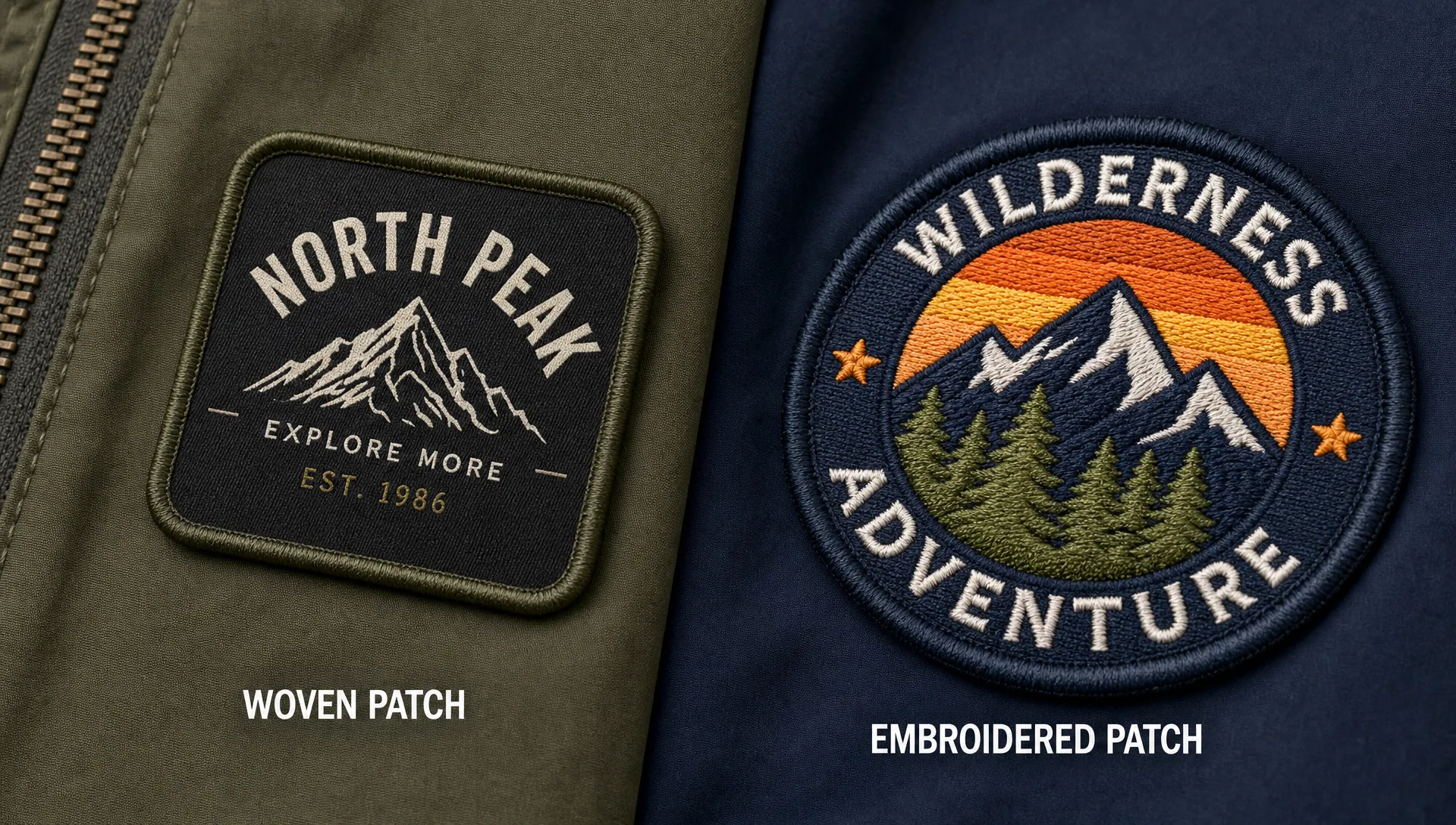
The short answer is that custom woven patches usually look better for fine detail, small text, clean logos, and modern brand marks, while embroidered patches often look better for bold designs, vintage styling, raised texture, and rugged apparel. Neither is automatically more attractive. The better choice depends on the design, the fabric it will sit on, and the impression you want your brand to make.
This guide focuses on appearance, finish, and brand fit. If you want a deeper technical breakdown of how each patch is made, HiLabels also has a full construction and durability comparison of embroidered and woven patches.
The core visual difference
Woven and embroidered patches are both made with thread, but they do not present artwork in the same way.
Custom woven patches are created by weaving fine threads together into the design. The surface is typically smoother and flatter, which allows logos, lettering, lines, and small shapes to appear sharper. They feel closer to a high-quality woven label, but in patch form.
Embroidered patches are made by stitching thread onto a fabric base. The stitches sit higher on the surface, creating a textured, dimensional look. That raised thread gives embroidered patches their classic, tactile appearance, but it can also make very small details appear thicker or less defined.
Think of woven patches as crisp and precise. Think of embroidered patches as textured and bold.
| Visual factor | Custom woven patches | Embroidered patches |
|---|---|---|
| Surface finish | Smooth, flat, refined | Raised, textured, tactile |
| Detail level | Better for fine lines and small text | Better for simple, bold shapes |
| Logo clarity | High clarity for intricate marks | Strong impact for simplified logos |
| Style impression | Modern, premium, polished | Heritage, rugged, classic |
| Best viewing distance | Close-up and medium distance | Medium and long distance |
| Common aesthetic fit | Fashion, lifestyle, accessories, retail branding | Workwear, uniforms, clubs, outdoor gear |
When custom woven patches look better
Custom woven patches look especially strong when the artwork needs to stay clean. If your logo includes thin lines, small type, compact symbols, or a detailed illustration, weaving can preserve more of the original design.
This matters for modern apparel brands because many logos today are minimalist, geometric, or typography-led. A raised embroidered stitch can make a thin sans-serif logo look heavier than intended. A woven patch can keep the design closer to the original brand file.
Woven patches also work well when you want a refined finish. The flatter surface can feel more subtle on premium clothing, bags, hats, and accessories. Instead of looking like an add-on, the patch can look integrated into the product.
They are often the better-looking option for:
- Small logos that need crisp edges
- Detailed badges with multiple shapes or lines
- Typography-based brand marks
- Fashion labels that want a clean finish
- Product lines where consistency across sizes matters
- Premium accessories where bulk would feel distracting
A woven patch can also be useful when the patch itself is small. On a small patch, every thread counts. Embroidery can become crowded because the stitches have physical height and width. Woven construction gives the design more room to breathe.
When embroidered patches look better
Embroidered patches have a visual personality that woven patches do not fully imitate. They look dimensional, tactile, and instantly recognizable. For some brands, that texture is exactly the point.
A bold embroidered patch can make a jacket, cap, backpack, or uniform feel substantial. It catches light differently because the thread is raised. It also communicates durability and tradition, which is why embroidery remains popular for workwear, military-inspired apparel, sports teams, clubs, and outdoor brands.
Embroidered patches often look better when the design is simple and graphic. Large block letters, mascots, shield shapes, numbers, and high-contrast symbols can all benefit from the raised thread. The patch becomes less about tiny detail and more about presence.
They are often the better-looking option for:
- Varsity, biker, outdoor, or heritage-inspired designs
- Patches meant to stand out from a distance
- Uniforms and team gear with bold identification
- Thick jackets, denim, canvas, and workwear fabrics
- Designs where texture is part of the brand aesthetic
- Simple logos that can be slightly stylized in thread
If your patch is meant to feel tough, traditional, or collectible, embroidery can look more natural than weaving. The texture gives it character.
Which looks more premium?
This is where many buyers get stuck. Embroidery is often associated with premium decoration because it has dimension and a handcrafted feel. But custom woven patches can look more premium when the design demands precision.
A premium look comes from alignment between material, artwork, and use case. A raised embroidered patch on a heavy denim jacket can look high-end. The same embroidered patch on a lightweight fashion tee might feel bulky. A woven patch on a minimalist overshirt can look sophisticated. The same woven patch on a rugged canvas field jacket might feel too flat if the brand wanted a traditional workwear look.
For retail brands, the premium choice is often the one that best protects the logo. If your logo is highly recognizable and depends on exact proportions, woven patches are usually safer. If your brand identity is built around craft, texture, or heritage, embroidery may feel richer.
This same principle applies beyond apparel. Growing teams that invest in hiring, onboarding, events, and internal culture often need visual consistency across multiple brand touchpoints. A company expanding internationally, for example, may work with an international recruitment agency while also refining employee apparel, welcome kits, and event merchandise. In that context, the better-looking patch is the one that keeps the brand recognizable wherever it appears.
Side-by-side design scenarios
The easiest way to choose is to imagine your actual artwork as a finished patch. Here are common scenarios where one option tends to look better than the other.
Small text or fine lettering
Choose woven. Small letters can lose readability when embroidered because stitch thickness limits precision. Woven threads can create sharper letterforms, especially on compact labels, sleeve patches, or small accessory patches.
Bold block lettering
Choose embroidered if you want impact. Large letters with enough spacing can look excellent in embroidery because the raised stitches make the wordmark feel strong and dimensional.
Detailed illustration
Choose woven for cleaner translation. If the artwork includes facial features, thin outlines, small icons, or layered details, woven construction usually captures more nuance.
Retro badge or club patch
Choose embroidered if texture is part of the charm. A vintage hiking club patch, motorcycle-style emblem, or varsity-inspired badge often benefits from the classic raised stitch look.
Premium fashion branding
Choose woven for a cleaner, flatter finish. Many fashion and lifestyle brands want patches that feel polished rather than bulky, especially on lighter garments or minimalist products.
Heavy outerwear and gear
Choose embroidered if you want the patch to feel tough and visible. On denim, canvas, field jackets, and gear bags, the thicker texture can look intentional and durable.
How fabric changes the way a patch looks
The garment or product matters almost as much as the patch type. A patch does not exist in isolation. It has to sit naturally on the surface below it.
On thin or soft fabrics, a flatter woven patch often looks cleaner because it adds less visual bulk. This can be especially important for lightweight jackets, fashion tees, children’s apparel, scarves, and accessories.
On thick or structured fabrics, embroidery can look balanced because the garment can visually support the raised texture. Denim jackets, canvas bags, twill uniforms, and wool blends can all handle a bolder patch.
Color and contrast also affect the result. A detailed woven patch with low-contrast colors may look elegant up close but subtle from far away. An embroidered patch with strong contrast may be more visible across a room, even if it contains less detail.
If you are still deciding where the patch will go, it helps to first choose patch styles by garment type. Placement, fabric weight, and usage can quickly narrow your options.
The role of borders, backing, and edge finish
Patch type is only part of the visual outcome. Borders and backing also influence the final look.
A merrowed edge can give a patch a traditional, rounded border, which pairs well with many embroidered designs. A laser-cut or heat-cut edge can look cleaner and more modern, especially for woven patches with unusual shapes or fine details near the edge.
Backing matters because it affects how flat the patch sits. A sew-on patch can feel more integrated and long-lasting, while an iron-on backing can be convenient for certain garments and smaller runs. The right choice depends on fabric, wash needs, and how permanent the application should be. If application method is a major factor, compare sew-on and iron-on patch backings before finalizing your design.
The visual takeaway is simple: even the best patch type can look wrong if the edge, backing, or placement does not match the garment.
A practical decision guide
If your main goal is a sharper, cleaner, more design-accurate patch, custom woven patches are usually the stronger choice. They are especially helpful for brand marks that must stay legible and proportional.
If your main goal is a bold, tactile, classic patch with visible dimension, embroidered patches may look better. They are ideal when texture is part of the message.
Use this quick guide before ordering:
- Choose woven if your design has small text, thin lines, detailed artwork, or a modern premium look.
- Choose embroidered if your design is bold, simple, vintage-inspired, or intended to stand out on heavy fabric.
- Choose woven if you want the patch to sit flatter on the garment.
- Choose embroidered if you want a raised, dimensional surface.
- Choose woven for close-up brand clarity.
- Choose embroidered for strong visual impact from a distance.
When in doubt, simplify the artwork first. Both woven and embroidered patches look better when the design is adapted to the medium instead of forced into it.
Common design mistakes to avoid
A patch can only look as good as the artwork allows. Many disappointing results happen because the original design was not adjusted for thread.
One common mistake is using too many tiny elements. Even woven patches have limits. If a logo includes very small text, thin outlines, gradients, or photographic detail, it may need to be simplified before production.
Another mistake is assuming embroidery will reproduce a digital logo exactly. Embroidery has charm because it is textured, but that texture changes the look of curves, corners, and letterforms. A logo that looks perfect on a screen may need slightly thicker spacing or fewer details to look good in embroidery.
Color selection also matters. Thread colors are physical materials, so they may not behave exactly like backlit digital colors. Strong contrast usually improves readability, especially for patches viewed from a distance.
Finally, do not ignore scale. A design that works beautifully at four inches wide may not work at one inch wide. Before approving a patch, view the artwork at the actual finished size.
So, which one looks better?
For most detailed brand logos, custom woven patches look better because they provide cleaner lines, smoother surfaces, and stronger small-detail clarity. They are a strong choice for fashion brands, product labels, accessories, and any design where precision is part of the brand value.
For bold, classic, or rugged designs, embroidered patches look better because the raised texture adds personality and visual weight. They are a strong choice for uniforms, jackets, clubs, teams, outdoor gear, and heritage-inspired apparel.
The best-looking patch is not the one with the most decoration. It is the one that makes your design feel intentional on the finished product.
Frequently Asked Questions
Are custom woven patches better than embroidered patches? Custom woven patches are better for fine detail, small text, and clean logo reproduction. Embroidered patches are better when you want raised texture, bold shapes, and a classic patch appearance.
Do woven patches look cheaper than embroidered patches? Not necessarily. Woven patches can look very premium when used for crisp branding, fashion apparel, and detailed artwork. Embroidery can look more premium on rugged garments when texture supports the design.
Which patch type is better for small lettering? Woven patches are usually better for small lettering because the flatter woven construction can preserve cleaner letter shapes than raised embroidery.
Which patch type is better for jackets? It depends on the jacket style. Embroidered patches often look great on denim, canvas, and varsity-style jackets. Woven patches can look better on lightweight, minimalist, or premium fashion jackets.
Can I use both woven and embroidered patches for the same brand? Yes. Many brands use woven patches for detailed product branding and embroidered patches for bold merch, uniforms, or outerwear. The key is keeping colors, shapes, and brand standards consistent.
Create a patch that fits your brand
If your design needs crisp detail, a smooth finish, and a premium branded look, custom woven patches are often the best place to start. If you want a bolder, textured, heritage-style result, embroidery may be the better match.
HiLabels helps brands create professional custom woven labels, patches, ribbons, zipper pulls, and care labels with a user-friendly ordering process and experienced support. Start with your artwork, think about where the patch will be used, and choose the finish that makes your brand look its best.


