Custom Woven Labels for Clothing Brands That Want to Scale
Scaling a clothing brand changes the job of a label. In the early days, a label may simply identify who made the garment. Once you start selling through more channels, producing more SKUs, working with contractors, or approaching wholesale buyers, that same label becomes part of your operating system.
A strong product line needs consistency. Customers should recognize your pieces whether they find them on your website, in a boutique, at a pop-up, or through a reseller. Production partners need clear specifications. Retailers want products that feel finished. This is where custom woven labels for clothing become more than a branding detail. They help growing apparel brands look organized, premium, and ready for repeatable production.
The goal is not to make the most elaborate label possible. The goal is to choose a woven label system that can scale with your garments, your packaging, your inventory, and your customer expectations.
Why scaling brands outgrow generic labels
Generic labels can work for samples, one-off pieces, or very small runs. But they start to create friction as soon as your brand needs consistency across batches. A garment with a beautiful fit can still feel unfinished if the label looks temporary, fades too quickly, scratches the wearer, or changes from one production run to the next.
Scaling also exposes small inconsistencies. A logo that looks acceptable on a hangtag may become unreadable when woven into a tiny neck label. A color that seemed close enough on one batch may look off when placed next to a later reorder. A label that is too large for one product category may work on outerwear but overwhelm lightweight basics.
For growing brands, the label should answer three questions quickly:
- Who made this garment?
- Does the product feel professionally finished?
- Can this branding be repeated across future production runs?
When the answer is yes, labels support both customer trust and operational efficiency.
Why woven labels work especially well as volume increases
Woven labels are made with thread, which gives them texture, durability, and a more integrated feel than many temporary branding elements. They are commonly used for main brand labels, neck labels, hem tags, size markers, patches, and other garment details where longevity matters.
As your order volume increases, durability becomes more important. Customers may wash and wear a garment dozens of times. If the label frays, fades, or feels uncomfortable, it can affect how they perceive the entire product. A woven label helps the brand mark remain part of the garment experience for the long term.
| Scaling challenge | Label decision that helps | Why it matters |
|---|---|---|
| More styles and SKUs | Create a consistent label family | Keeps branding recognizable across the line |
| Wholesale presentations | Use polished woven brand labels | Helps garments look retail-ready |
| Repeat production runs | Save exact label specifications | Reduces variation between batches |
| Higher customer expectations | Choose comfortable folds and placement | Improves the wearing experience |
| More complex inventory | Separate brand, size, and care information | Makes production and fulfillment easier |
Scaling is also a credibility game. The principle is not limited to apparel. A specialist service business such as Kvalifuge ApS builds confidence by making reviews, awards, service areas, and contact paths visible because buyers need proof before they commit. Your garment label plays a smaller but similar role: it turns an anonymous product into something traceable, intentional, and recognizable.
Decide whether you need a single label or a label system
Many clothing brands start by ordering one main woven label. That is a logical first step, but a growing brand often needs a complete label system. A system lets each label do one job well rather than forcing too much information into one small space.
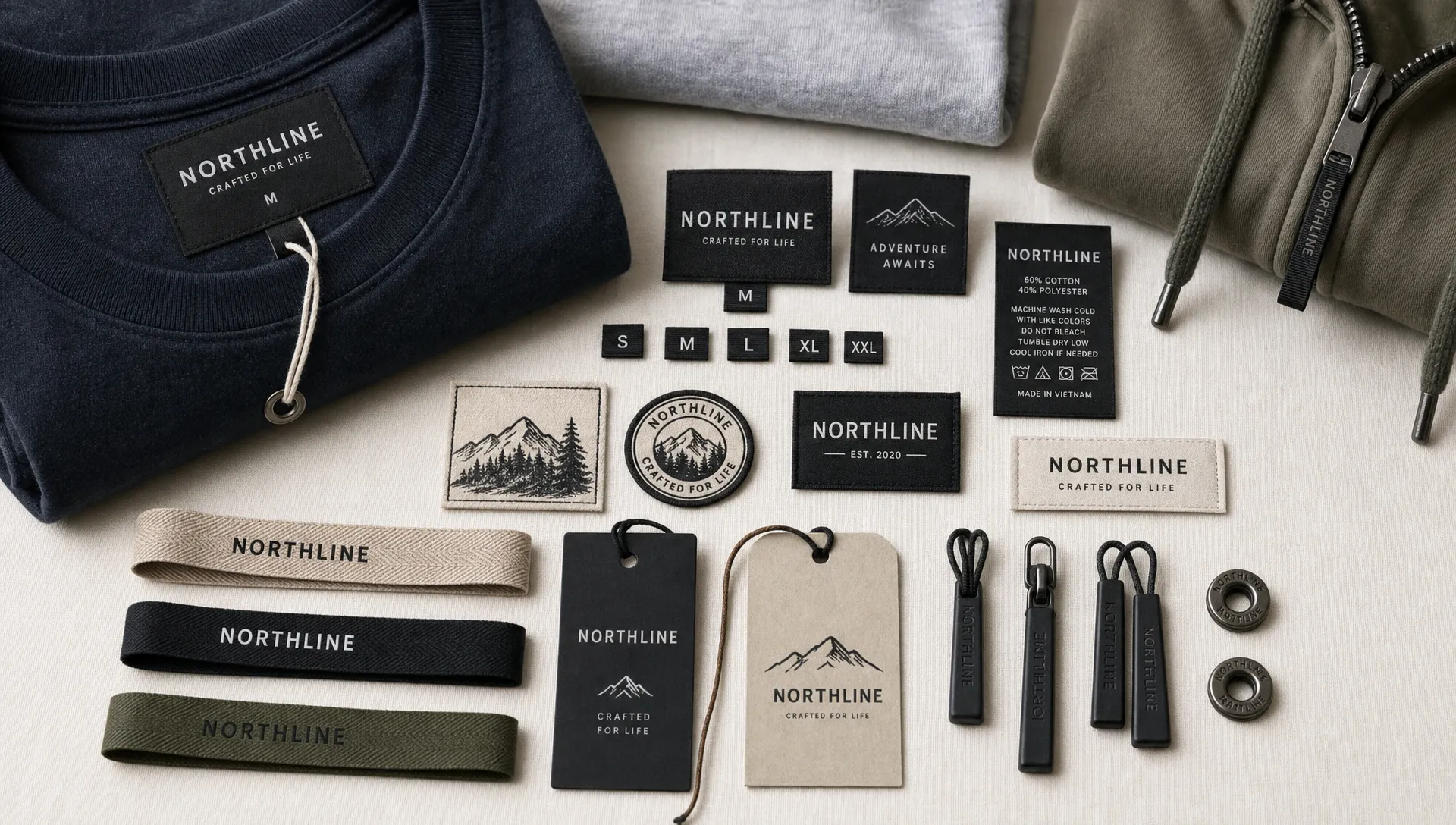
A main woven label can carry the logo or brand name. A separate size label can simplify inventory across XS, S, M, L, and extended sizes. A care label can communicate fiber content and washing instructions. A hem label, patch, ribbon, or zipper pull can add brand recognition in a more visible or tactile way.
If you are still deciding between label formats, it can help to review how different tag types affect garment branding, placement, and production. HiLabels has a practical guide to choosing custom fabric tags for clothing brands that covers many of these decisions in more detail.
Woven vs. printed: choose the right label for the job
Woven labels are excellent for logos, brand names, simple icons, and durable garment branding. Printed labels can be better for very small text, detailed care instructions, fiber content, QR codes, and artwork with fine gradients.
This is especially important when scaling. A logo label and a care label may not need the same production method. If you try to put too much small information into a woven label, readability can suffer. If you use printing for every brand mark, you may lose some of the texture and premium feel that woven labels provide.
For many apparel brands, the best approach is a mix: woven labels for the brand identity and printed labels for technical or regulatory information. If you are weighing both options, this comparison of printed woven labels for growing apparel brands can help you decide where each format fits.
Build specifications that can survive reorders
The brands that scale smoothly do not treat labels as a last-minute accessory. They document them. Your label specifications should be clear enough that a production partner, sewing contractor, or future team member can understand exactly what to reorder.
Important specifications include label dimensions, fold type, background color, thread colors, logo placement, seam allowance, application method, and intended garment placement. If you create multiple labels for different collections, keep those specs organized by product line.
This discipline matters because reorders are where scaling brands often lose consistency. A label that is slightly too wide may affect how it fits into a neckline. A fold that changes may alter how it is sewn. A thread color that is not documented may drift away from your brand palette over time.
Design rules for scalable custom woven labels
A woven label is not a paper business card. Thread has structure, and small details need room to be legible. The most scalable woven label designs are usually the ones that are clear, simple, and adaptable.
Simplify the logo without weakening the brand
If your logo includes tiny lines, distressed textures, shadows, or delicate lettering, consider creating a label version of the logo. This does not mean changing your identity. It means adapting the mark so it weaves cleanly at small sizes.
A simplified label logo often performs better across neck labels, side tabs, patches, and packaging ribbons. It also gives you more flexibility if you later introduce kidswear, accessories, outerwear, or limited-edition capsule collections.
Choose contrast before complexity
Readable labels usually have strong contrast between the background and thread colors. A subtle tonal label can look elegant, but it must still be legible in real use. Test how your label will look inside darker garments, against textured fabrics, and under retail lighting.
For scaling brands, color consistency is particularly important. Choose colors that align with your brand identity, then keep those references documented for future orders.
Match the fold to the garment
The fold affects comfort, sewing, and appearance. A centerfold label works well for many neck applications because the seam can hide the unfinished edge. End-fold labels create a clean look on flat surfaces. Straight-cut labels may work for patches or applications where the edges are intentionally visible or sewn down.
The best fold depends on the garment, fabric weight, and placement. A hoodie, silk blouse, denim jacket, and baby bodysuit may each need a different label solution.
Think about touch as much as appearance
A label can look perfect and still disappoint if it irritates the wearer. This is especially important for neck labels, children’s clothing, intimates, activewear, and lightweight garments. Scaling brands should consider how the label feels after sewing and washing, not just how it looks in a product mockup.
What to include in a scalable label system
Not every brand needs every label type immediately. But planning the system early helps you avoid redesigning everything when your product range grows.
| Label or branding item | Role in a scaling brand | Common placement or use |
|---|---|---|
| Main woven label | Carries the core brand identity | Neck, waistband, inner seam, or outerwear lining |
| Size label | Simplifies production and customer selection | Near main label or inside seam |
| Care label | Communicates wash and material information | Side seam or inner garment area |
| Hem or side tab | Adds subtle external recognition | Sleeve, hem, pocket, or side seam |
| Patch | Creates a stronger visual branding moment | Denim, hats, bags, jackets, or workwear |
| Ribbon | Extends branding into packaging or trims | Gift wrap, product bundles, or garment details |
| Zipper pull | Adds tactile branding to functional hardware | Jackets, bags, hoodies, or accessories |
A system like this gives you room to grow. You may start with a main woven label, then add size labels, care labels, patches, or ribbons as your line expands.
Prepare artwork like a production team, not a hobby brand
Before placing a larger label order, review your artwork carefully. High-quality artwork helps reduce errors, delays, and interpretation issues. It also gives your supplier the best chance of producing a label that matches your expectations.
Useful preparation steps include confirming the final label size, checking that text remains readable, simplifying fine details, choosing brand-approved colors, and noting the intended placement. If you have existing artwork, make sure you upload the cleanest available file and include any relevant design notes.
HiLabels makes this process easier through an online creation tool where you can create custom woven clothing labels by choosing label type, application method, finish, size, colors, and artwork options. For scaling brands, that kind of structured ordering process can help keep details from getting lost between design, production, and reorder planning.
Common label mistakes that slow growth
A label mistake may seem small, but small problems multiply when you move from 50 garments to 500 or 5,000. The most common issues are usually preventable with better planning.
| Mistake | Why it hurts scaling | Better approach |
|---|---|---|
| Designing too small | Logo or text becomes unreadable | Test the design at actual label size |
| Using too many colors | Weaving becomes harder to control | Prioritize essential brand colors |
| Ignoring seam allowance | Label may sew awkwardly or lose visible space | Confirm fold and stitch area before ordering |
| Combining all information | Label becomes crowded and uncomfortable | Separate brand, size, and care details |
| Changing specs often | Reorders look inconsistent | Document approved label standards |
| Waiting until the end | Labels delay production timelines | Order labels early in the development cycle |
The strongest apparel brands treat labels as part of product development. They review them alongside fabric, trims, packaging, and fit because all of those details influence the finished customer experience.
When should a clothing brand upgrade to custom woven labels?
You do not need to wait until you are selling thousands of units. A good time to upgrade is when you know your brand identity is stable enough to repeat and your products are being sold to real customers. If you are preparing for wholesale, launching a new collection, improving packaging, or investing in better photography, custom woven labels can help the full presentation feel more mature.
They are also useful when customer retention matters. A hangtag may be removed immediately, but the woven label stays with the garment. Every time the customer wears, washes, folds, lends, or resells the item, your brand remains attached to the product.
How HiLabels supports growing apparel brands
HiLabels offers custom woven labels, ribbons, patches, zipper pulls, and care labels for clothing and product brands that want durable, professional branding materials. With more than 31 years of experience and a focus on superior European loom quality, HiLabels is built for brands that care about craftsmanship as well as ease of ordering.
For a scaling brand, the advantage is practical. You can upload artwork, choose important label details online, and create a label that matches your product direction. That keeps the process accessible whether you are refining your first serious collection or standardizing labels for future reorders.
Frequently Asked Questions
Are custom woven labels for clothing worth it for small brands that plan to scale? Yes. If your brand identity is stable and you are selling finished garments, woven labels can make your products look more professional and help create consistency before volume increases.
What information should go on a woven clothing label? A main woven label usually works best with a logo, brand name, or simple icon. Size, care, fiber, and compliance details are often better handled on separate size or care labels.
How do I make sure my woven label is readable? Use clear contrast, avoid tiny text, simplify detailed artwork, and test the design at the actual finished size. A clean logo usually scales better than a complex one.
Can one woven label work across every garment type? Sometimes, but not always. Different fabrics, garment weights, and placements may require different sizes, folds, or label types. A label system is often more flexible than one universal label.
When should I order labels during production? Order labels early enough that they do not delay cutting, sewing, finishing, or packing. Scaling brands should treat labels as production components, not last-minute accessories.
Ready to create labels your brand can grow with?
Scaling is easier when the details are repeatable. A custom woven label gives every garment a consistent brand signature, supports a more polished presentation, and helps your product line feel ready for customers, retailers, and future reorders.
If your clothing brand is preparing for bigger production runs, new sales channels, or a more premium customer experience, HiLabels can help you turn your artwork into durable, professional labels designed for real garments and long-term brand recognition.


