How to Choose a Reliable Custom Patch Factory
A patch is small, but it carries a lot of responsibility. It may be the first detail a customer notices on a jacket, backpack, uniform, hat, or limited-edition merch piece. If the stitching is uneven, the colors look off, or the backing fails after a few wears, the entire product can feel cheaper than intended.
That is why choosing a reliable custom patch factory is not just a sourcing decision. It is a brand decision. The right partner helps you turn artwork into durable, attractive patches that match your product, timeline, and quality expectations. The wrong one can create delays, inconsistent batches, wasted inventory, and frustrated customers.
This guide walks through the practical criteria to evaluate before placing an order, especially if you are building an apparel brand, outfitting a team, launching merchandise, or upgrading product packaging.
Start by defining what “reliable” really means
A reliable patch factory is not simply the one with the lowest quote or fastest promised turnaround. Reliability is the combination of product quality, clear communication, accurate proofs, consistent production, and the ability to deliver what was approved.
For most brands, reliability comes down to five questions:
- Can the factory reproduce your artwork accurately at patch size?
- Does it offer the right patch construction for your product?
- Are samples, proofs, and revisions handled clearly?
- Will the finished patches withstand real use?
- Is the team responsive when you need guidance or support?
If a supplier performs well in all five areas, you are far more likely to receive patches you can confidently sew, heat press, package, or ship with your products.
Know your patch requirements before comparing factories
Before you request quotes, define the use case. A patch for a denim jacket is different from a patch for a tactical bag, a youth sports uniform, or a fashion hoodie. The clearer your requirements are, the easier it is to compare factories fairly.
At minimum, prepare these details before contacting suppliers:
- Patch size and shape
- Quantity needed
- Preferred patch type, such as woven, embroidered, printed, chenille, or PVC
- Backing method, such as sew-on, iron-on, adhesive, or hook-and-loop
- Garment or product fabric
- Artwork file, brand colors, and any text that must remain legible
- Target delivery date
- Any packaging, labeling, or compliance needs
If you are still deciding which patch type fits your apparel line, HiLabels has a useful guide on choosing the right patches for any apparel line that explains how garment type, placement, and durability expectations affect the best choice.
The key is to avoid asking factories for a vague quote like “How much for custom patches?” Instead, give them enough information to recommend the right construction and identify potential design issues early.
Evaluate the factory’s patch-making capabilities
A dependable custom patch factory should be able to explain the strengths and limits of different patch types. Not every design works equally well in every construction.
For example, embroidered patches have a raised, textured look that works well for bold logos and classic branding. Woven patches are better for fine detail, small lettering, and crisp edges because the design is woven with thread rather than built with thicker embroidery stitches. Printed patches can reproduce gradients, photos, and complex artwork, while specialty styles can create a more dimensional or tactile effect.
| Patch type | Best for | Watch out for |
|---|---|---|
| Woven patches | Fine details, small text, clean logos, fashion branding | Less raised texture than embroidery |
| Embroidered patches | Bold logos, heritage looks, uniforms, caps, outerwear | Very small text may lose clarity |
| Printed patches | Gradients, illustrations, photo-like artwork | Surface finish and durability should be reviewed |
| Chenille patches | Varsity styles, large letters, statement pieces | Not ideal for tiny details |
| PVC or rubber patches | Outdoor gear, tactical items, modern branding | Different feel from fabric-based patches |
A factory does not need to offer every possible patch type to be reliable. In fact, specialization can be an advantage. What matters is that the team understands the format you need and can advise honestly when your artwork should be adjusted.
For brands comparing texture and detail, the differences between custom embroidered patches and woven patches are especially important. Choosing the right method upfront can prevent disappointing results later.
Inspect samples like a quality-control buyer
Samples are one of the best ways to judge a factory before placing a larger order. If possible, ask for physical examples of similar work. Photos can help, but they do not always show thickness, hand feel, edge quality, thread density, or backing strength.
When reviewing samples, look closely at the areas that usually reveal manufacturing quality. Edges should be clean, borders should be consistent, and the design should not look distorted. Small letters should be legible if the patch type and size are suitable for them. Colors should be close to the approved reference, although exact color reproduction can vary by thread, fabric, and production method.
Also check the back of the patch. A clean reverse side often indicates controlled production. For iron-on patches, the adhesive should be evenly applied. For hook-and-loop patches, the backing should align cleanly with the patch shape. For sew-on patches, the border should make installation straightforward.
A good sample review should answer a simple question: would you feel confident attaching this patch to a product your customer paid full price for?
Review the artwork and proofing process
A reliable factory will not simply accept your artwork and move straight to production without review. It should check whether the design can be produced clearly at the requested size and in the selected patch type.
This is especially important for small patches, detailed logos, gradients, thin lines, and tiny text. A design that looks perfect on a large screen may become crowded or unreadable when reduced to a 2-inch patch. The factory should be able to suggest adjustments, such as increasing line thickness, simplifying details, resizing text, or choosing woven instead of embroidered construction.
The proofing process should be clear and documented. You should know what you are approving, what can still change, and what happens if revisions are needed. Digital proofs are helpful for layout and color planning, but they are not always a perfect representation of texture or thread behavior.
HiLabels supports online customization and artwork upload, which can make this step easier for brands that already have a logo, sketch, or finished design file. More importantly, personalized customer service helps ensure that the production approach matches the brand’s intent rather than forcing every design into the same template.
Match backing and application to real-world use
A patch is only successful if it stays attached and performs well on the product. That makes backing selection just as important as the front-facing design.
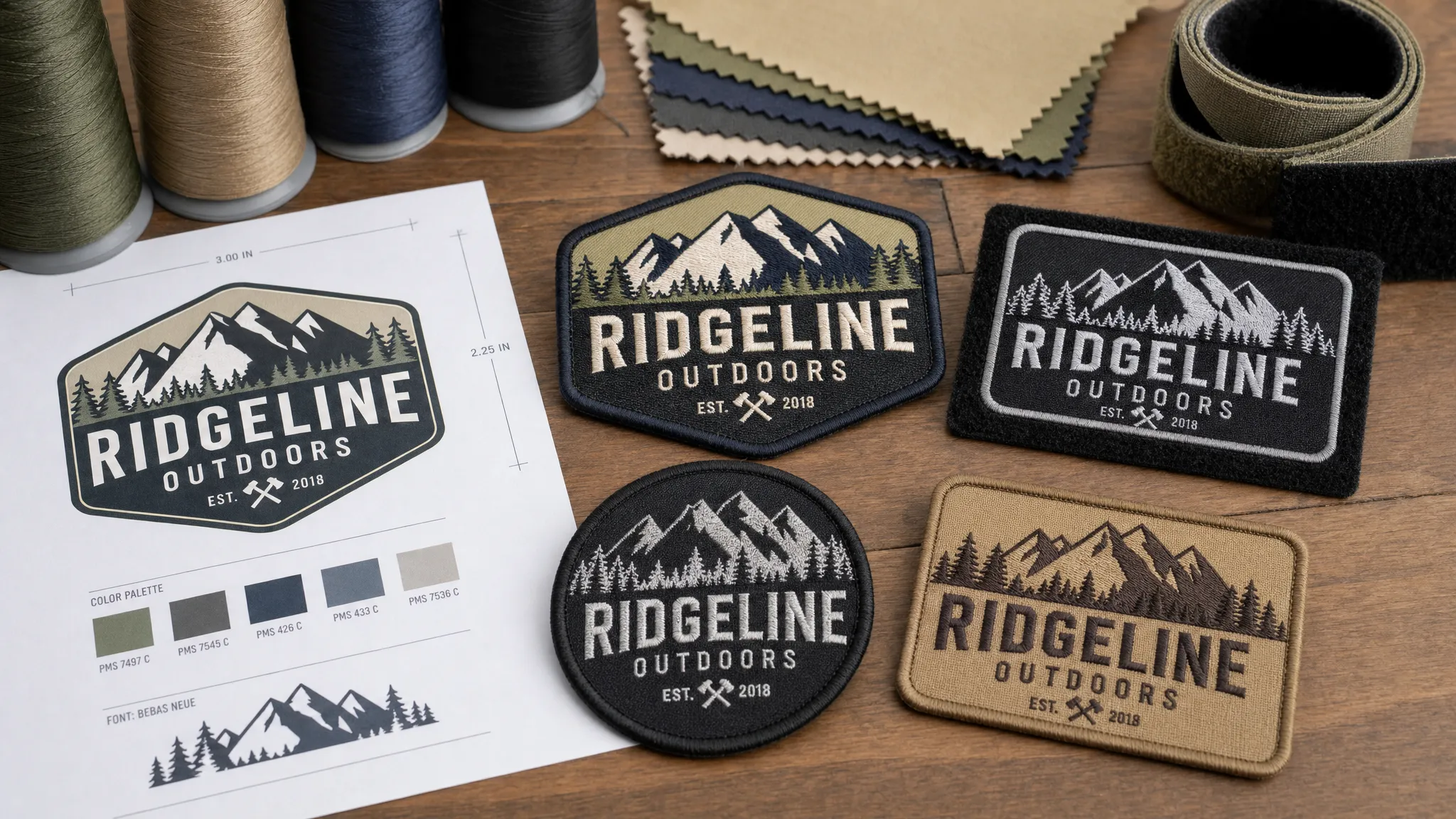
Sew-on patches are often preferred for long-term durability, especially on garments that will be washed frequently or used heavily. Iron-on patches are convenient and can work well for many apparel applications, but fabric compatibility, heat settings, and care instructions matter. Hook-and-loop patches are ideal when patches need to be removable or interchangeable, such as on uniforms, bags, tactical gear, or event apparel.
| Backing option | Common use | Key consideration |
|---|---|---|
| Sew-on | Jackets, denim, uniforms, bags, premium apparel | Strong, permanent attachment when stitched properly |
| Iron-on | Casual apparel, merch, DIY applications | Requires compatible fabric and correct heat application |
| Adhesive | Temporary use, events, packaging, short-term placement | Not usually the best choice for long-term wear |
| Hook-and-loop | Teams, gear, uniforms, tactical products | Adds removability and easy swapping |
If you are specifically considering heat-applied patches, this buyer’s guide to custom iron-on patches covers construction, backing, size, and artwork considerations in more detail.
Ask about durability, washing, and care expectations
Patch durability depends on materials, construction, backing, attachment method, and how the finished garment is used. A reliable factory should be willing to discuss how the patch will perform, not just how it will look.
For apparel, ask whether the patch style is suitable for washing, abrasion, outdoor exposure, or repeated handling. For bags and gear, ask how the border and backing hold up under friction. For uniforms, ask about consistency across reorders, since future batches may need to match the original production run.
Care instructions are also part of the customer experience. If the patch requires specific washing or drying conditions, you should know before launch. This is particularly important for brands that also use care labels, since the patch and garment care guidance should not conflict.
HiLabels offers both custom patches and care labels, which can help apparel brands keep branding and care communication aligned across the finished product.
Compare turnaround honestly, not just optimistically
Fast production is valuable, but unrealistic timelines are a red flag. A dependable custom patch factory should be transparent about each stage: artwork review, proof approval, production, quality checks, and shipping.
When comparing timelines, ask whether the quoted turnaround begins when you submit your order or when you approve the proof. Those are not the same. Delays often happen because artwork needs revisions or approvals sit unanswered. A factory with a clear process will help you understand your responsibilities as well as theirs.
If you have a hard deadline, such as a product launch, trade show, team event, or seasonal drop, communicate it upfront. Then ask the factory whether your schedule is realistic for the patch type, quantity, and shipping destination. A trustworthy supplier will set expectations rather than promise anything just to win the order.
Look for consistency and reorder confidence
For one-off projects, a good first run may be enough. For growing brands, consistency matters more. You need to know that a reorder six months from now will match the original patch closely enough to sit on the same product line.
Ask how the factory stores artwork files, production notes, colors, and specifications for future orders. Also ask whether there may be slight variations between batches. Some variation is normal in textile production, but it should be controlled and communicated.
This is where experience matters. A factory with decades in custom textile branding is more likely to understand how to manage repeat orders, advise on production limitations, and prevent avoidable surprises. HiLabels brings more than 31 years of experience in custom woven labels, patches, ribbons, zipper pulls, and care labels, supported by high-quality craftsmanship and European loom expertise.
Assess communication before you commit
The way a factory communicates before the order often predicts how it will communicate during production. Pay attention to the first few interactions.
Do they answer your questions directly? Do they explain tradeoffs clearly? Do they ask about the garment, use case, and deadline? Do they help you avoid mistakes, or do they only push for checkout?
Strong communication is especially important if you are new to custom patches. The best factories act like production partners. They translate technical details into practical decisions, such as whether a border should be merrowed or laser-cut, whether a logo needs simplifying, or whether a backing will work on the intended fabric.
This does not mean every email must be instant. It means responses should be useful, accurate, and consistent. If you feel confused before paying, you may feel even more confused if an issue appears after production starts.
Verify reputation, transparency, and brand fit
Credibility matters in any B2B buying decision. Before ordering, review the factory’s website, product photos, ordering process, customer support options, and any available reviews or testimonials. A professional supplier should make it easy to understand what it offers and how to start.
Online visibility can also be a trust signal, although it should not replace product checks. Just as apparel brands invest in clear product pages and marketing so customers can find and evaluate them, many small businesses work with specialists such as SEO Bridge to improve discoverability and credibility online. When evaluating a patch supplier, use that same mindset: look for clear information, proof of real work, and a buying process that reduces uncertainty.
Brand fit matters too. A factory that is excellent for one market may not be ideal for another. A fashion label may prioritize fine detail and refined finishes. A team or club may care most about durability and repeat ordering. A creator launching merch may need guidance, fast setup, and flexible customization. Choose the factory that understands your category and can support the way you work.
Watch for red flags when choosing a custom patch factory
Even if a supplier looks appealing at first, certain warning signs should make you pause. These do not always mean the factory is bad, but they do mean you should ask more questions before committing.
Common red flags include vague material descriptions, no proofing process, unclear turnaround estimates, poor sample photos, inconsistent communication, and reluctance to explain limitations. Be cautious if a factory guarantees perfect reproduction of highly detailed artwork without reviewing size or patch type. Also be careful with quotes that are far lower than every other option, since the difference may show up in materials, finishing, or service.
A reliable supplier will not make every decision for you, but it will help you make informed choices. If the process feels rushed, opaque, or overly generic, keep looking.
Questions to ask before placing your order
Once you have narrowed your options, a short set of questions can reveal a lot about process and professionalism. You do not need to interrogate the supplier, but you should understand how your order will be handled.
Ask questions such as:
- Which patch type do you recommend for this artwork and why?
- Will small text or thin lines reproduce clearly at this size?
- What backing is best for the garment or product I am using?
- Will I receive a proof before production begins?
- When does the production timeline officially start?
- How do you handle revisions before approval?
- Can future reorders match this design and specification?
- What should I know about washing, heat, abrasion, or care?
The quality of the answers matters as much as the answers themselves. A trustworthy factory should be able to explain the reasoning behind its recommendations.
Why HiLabels is a strong choice for custom patches
HiLabels is built for brands and creators that need custom textile branding products with dependable quality and a straightforward ordering experience. In addition to custom patches, HiLabels offers custom woven labels, ribbons, zipper pulls, and care labels, making it easier to create a consistent branded finish across apparel, accessories, and packaging.
The online label creation and artwork upload process helps simplify setup, while bespoke product options and personalized customer service support more specific needs. For brands that care about detail, durability, and a polished final product, HiLabels’ long experience and superior European loom quality are meaningful advantages.
If you are choosing a factory for the first time, the goal is not only to buy patches. It is to build a repeatable production relationship that protects your brand as you grow.
Frequently Asked Questions
What makes a custom patch factory reliable? A reliable custom patch factory offers consistent quality, clear proofing, suitable material recommendations, transparent timelines, responsive support, and finished patches that match the approved design as closely as the production method allows.
Should I choose embroidered or woven patches? Choose embroidered patches for bold, textured designs and a classic raised look. Choose woven patches for fine details, small lettering, and crisp logo reproduction. The best option depends on your artwork, patch size, and garment type.
Do I need a sample before ordering custom patches? A sample is strongly recommended for larger orders, premium products, or designs with fine detail. At minimum, review similar physical samples and approve a clear digital proof before production begins.
What backing is best for custom patches? Sew-on backing is a strong choice for long-term durability. Iron-on backing is convenient for many apparel uses if the fabric is compatible. Hook-and-loop backing works best when patches need to be removable or interchangeable.
How early should I order patches before a launch? Order as early as possible, especially if you need design revisions, samples, or shipping by a fixed date. Always confirm whether the quoted timeline starts at order placement or after proof approval.
Ready to create patches your brand can stand behind?
The right patch factory should make your product feel more finished, not more complicated. By evaluating samples, materials, proofing, backing, durability, communication, and reorder support, you can choose a partner with confidence.
If you are ready to turn your design into high-quality custom patches, explore HiLabels’ custom branding options at HiLabels and start building patches that look sharp, wear well, and support your brand identity.


