Embroidered Name Labels for Clothes Without Oversharing
A lost sweater needs a way home, not a miniature contact card. Embroidered name labels for clothes can help identify belongings without displaying a child’s full name, school and family phone number to everyone nearby. The useful question is not how much information will fit, but how little someone needs to return the item.
That balance depends on where the clothing goes. A school uniform, camp sweatshirt and garment used in a care setting may need different identifiers. Start with the setting, then choose the wording, construction and placement.
Start with the minimum useful identifier
Before designing a label, ask the school, club, camp or care provider what information they require. A discreet label is only useful if the people sorting lost property can connect it to the right person.
The following options are starting points, not substitutes for an organization’s labeling policy:
| Setting | Possible label wording | What to confirm first |
|---|---|---|
| School with a central lost-property system | First initial and surname | Whether this distinguishes pupils with similar names |
| Day camp or sports club | First name and surname initial | Whether staff require a full surname or group identifier |
| Clothing shared between siblings | Family surname | Whether individual identification is necessary |
| Residential care or managed laundry | Facility-approved name or identifier | The exact format required for sorting and returning garments |
| Handmade gift | First name or short dedication | Whether the recipient wants permanent personalization |
For embroidered name labels for clothes, use the least information that still identifies the owner reliably. Initials alone may work in a small group but become confusing across an entire school.
Avoid adding a home address, date of birth or medical information to an ordinary ownership label. A phone number may help someone return clothing lost in a public place, but it also shares contact information with anyone who finds it. Decide whether that trade-off is necessary rather than including it automatically.
Separate visible personalization from private identification
A decorative name on the outside of a jacket serves a different purpose from an ownership label inside it. Exterior personalization is meant to be seen. An internal label is meant to be found when someone checks the garment.
If you want a visible design, consider a symbol, monogram or brand mark outside and a more useful identifier inside. Neither option guarantees anonymity, but separating decoration from identification gives you more control over what is casually visible.
Placing embroidered name labels for clothes inside the garment reduces everyday exposure without making them inaccessible to someone checking lost property. Choose a position that does not become visible when a collar folds back, a hood hangs down or a jacket is worn open.
Photographs deserve a separate check. An internal label can still appear when clothing is laid flat for a resale listing, photographed during packing or shown in a school-uniform post. Before sharing an image, inspect it for names and other identifiers, then crop or cover them where appropriate.
The aim is practical discretion, not a promise that a label will remain secret.
Buying embroidered name labels for clothes: what to check
Confirm whether the lettering is embroidered or woven
Product names can be confusing. In embroidery, threads are stitched into a base material to create the lettering. In a woven label, the lettering is formed within the fabric’s weave. Both can produce durable textile labels, but their construction and finished feel differ.
Check the supplier’s description rather than relying on a photograph or the word “stitched.” HiLabels offers custom woven labels, so its woven options should not be treated as embroidered products.
Small lettering also needs a realistic assessment. When comparing embroidered name labels for clothes, request a proof at the intended size and ask whether the chosen lettering can be reproduced clearly. A decorative script that looks attractive enlarged may be difficult to read on a narrow tag.
Check the reverse, edges and washing instructions
The front is only part of the decision. Ask about the reverse surface, edge finish and attachment method, especially when the label will sit against skin. Backing and finishing can matter as much as the visible stitching.
Compare the label’s washing instructions with the garment’s care requirements. Do not assume that every textile label tolerates tumble drying, high heat or a managed laundry process. For wearers sensitive to texture, the guide to personalized sewing labels for sensory-friendly clothing explains what to assess in a finished sample.
Write the label before opening a design tool
Start with the wording in plain text. This makes it easier to notice unnecessary details before colors, borders and lettering styles distract from the label’s purpose.
For a fictional pupil called Maya Bennett, “M. Bennett” might be sufficient if the school accepts it and there is no conflicting name. “Maya B.” may work in a small activity group. Neither format is universally better: the right choice depends on who needs to recognize it.
Check whether an identifier will become outdated. A class name, teacher’s name or annual camp group can shorten the useful life of a label. A family surname may suit clothing intended for siblings, provided the receiving organization does not require individual names.
Before ordering embroidered name labels for clothes, review these four details:
- Identification: Can the intended school, club or laundry team match the wording to the owner?
- Disclosure: Does every personal detail have a clear purpose?
- Legibility: Is the lettering readable at the actual production size?
- Longevity: Will the wording still work after a class change or transfer between siblings?
Leave enough space for the name to read clearly rather than filling the label with decoration. Check spelling, capitalization and punctuation on the final proof, particularly if several family members have similar names.
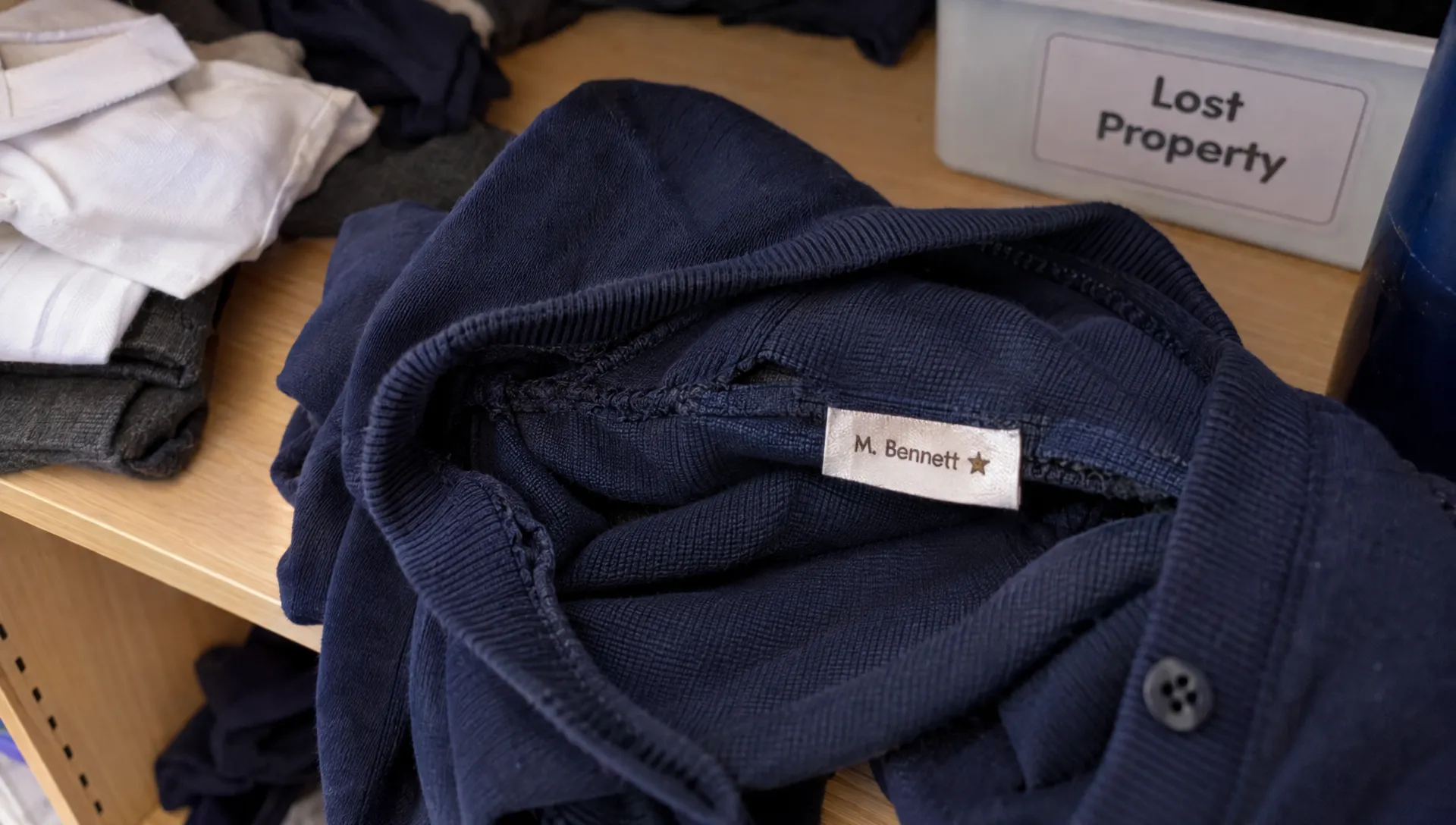
Attach it where it can be found without being on show
Good placement balances three things: discretion, comfort and easy checking. An inside neckline may be familiar to someone sorting clothing, but it can rub the wearer or show when the collar turns outward. An inside side seam may be less visible, although it should still be reasonably easy to locate.
For embroidered name labels for clothes, choose the attachment method after checking both the label and the garment. Sew-in labels need an appropriate stitching area. Iron-on labels require a suitable adhesive backing and fabric that can tolerate the specified heat. Do not assume an ordinary embroidered patch can be ironed on.
A removable fastening may suit temporary use, but assess whether it could detach or create an uncomfortable hard point. Avoid treating safety pins as a permanent solution for children’s everyday clothing.
Keep existing care instructions, size information and other required garment labels readable. If you are sewing the name label in yourself, the guide to sewing name labels for school clothes and handmade items covers attachment in more detail.
Test one finished garment before labeling the whole wardrobe. Have the wearer try it on, then wash and dry it according to the applicable instructions. Check for rubbing, curling edges, loose stitching and reduced readability.
Plan for hand-me-downs and clothing resale
Privacy decisions continue after the first owner stops wearing the garment. A permanent full name can remain inside a coat through donation, resale or several rounds of hand-me-downs.
If reuse matters, consider a separately attached label that can be removed without damaging the garment. Avoid stitching through an existing care label in a way that makes both difficult to separate later. For sibling sharing, a family identifier may reduce relabeling, but only where individual identification is not required.
Treat embroidered name labels for clothes as part of the handover checklist. Inspect the neckline, side seams, pockets and any additional labels before passing clothing on. Remove or replace the previous owner’s identifying details where practical, and check resale photographs too.
Do not rely on a thin marker line to conceal personal information permanently. The original lettering may remain readable or become visible as the ink fades. Removing the label or replacing it with a suitable new one is generally a more dependable approach, provided removal will not damage the garment.
Frequently asked questions
Should a child’s full name go on a clothing label? Use it when the school, camp or other organization requires it, or when a shorter identifier would be ambiguous. Otherwise, ask whether an initial and surname is sufficient. Place the label inside rather than treating it as exterior decoration.
Should I include a phone number? Only if direct contact is genuinely useful for the situation and you are comfortable sharing the number with whoever finds the item. Where lost clothing is returned through a school office or club, the required name may be enough.
Are embroidered name labels for clothes machine washable? Many are designed for laundering, but there is no universal washing specification. Check the supplier’s instructions for the label, backing and attachment method, then make sure they are compatible with the garment. Test a sample before committing to a full batch.
Are woven labels the same as embroidered labels? No. Woven lettering is formed in the weave, while embroidered lettering is stitched into a base material. Compare the actual construction, readability and finished feel rather than assuming the terms describe the same product.
Can I use a symbol instead of a name? A symbol can help the wearer recognize an item, but staff may not know who it belongs to. Use one alone only where the organization accepts it and has a reliable way to match it to the owner.
Create a label with only the details you need
Decide on the identifier and placement before choosing the finish. That order helps prevent unnecessary information from becoming part of a permanent design.
If woven construction suits your project, explore HiLabels’ custom woven label configurator to upload artwork and review the available design options. Keep the wording concise, check the proof at actual size and confirm that the finished label suits the garment’s wear and washing requirements.


