How to Choose Personalized Woven Labels for Your Brand
Personalized woven labels are small, but they carry a lot of weight. They tell shoppers who made the product, reinforce your brand every time the garment is worn, and signal whether your item feels handmade, boutique, premium, playful, sustainable, or mass-market.
For apparel brands, makers, designers, merch companies, and textile-based product businesses, choosing the right label is not just a design decision. It affects comfort, durability, compliance, production efficiency, and customer perception. A beautiful logo can still fall flat if the label is scratchy, too large, hard to read, or placed in the wrong spot.
This guide walks you through the main choices that matter when selecting personalized woven labels for your brand, so you can order with confidence and create a finish that feels intentional.
Start with the role your label needs to play
Before choosing colors, folds, or dimensions, decide what job the label needs to do. Not every woven label has the same purpose.
Some labels are meant to be highly visible and brand-forward, such as a hem tag on a T-shirt or an outside patch on a beanie. Others are quieter, like a soft neck label that reassures the customer the garment is professionally finished. You may also need a separate care label for fiber content, washing instructions, sizing, or country of origin information.
Ask yourself what the customer should understand from the label at a glance. If the goal is brand recognition, your logo or wordmark should be the hero. If the goal is product information, clarity matters more than decorative detail. If the goal is luxury positioning, materials, scale, and restraint become especially important.
A good personalized woven label should support your brand identity without distracting from the product itself.
Match the label style to your product type
The best label style depends heavily on where it will be used. A label that works beautifully inside a jacket may be uncomfortable inside a baby onesie or too subtle on a tote bag.
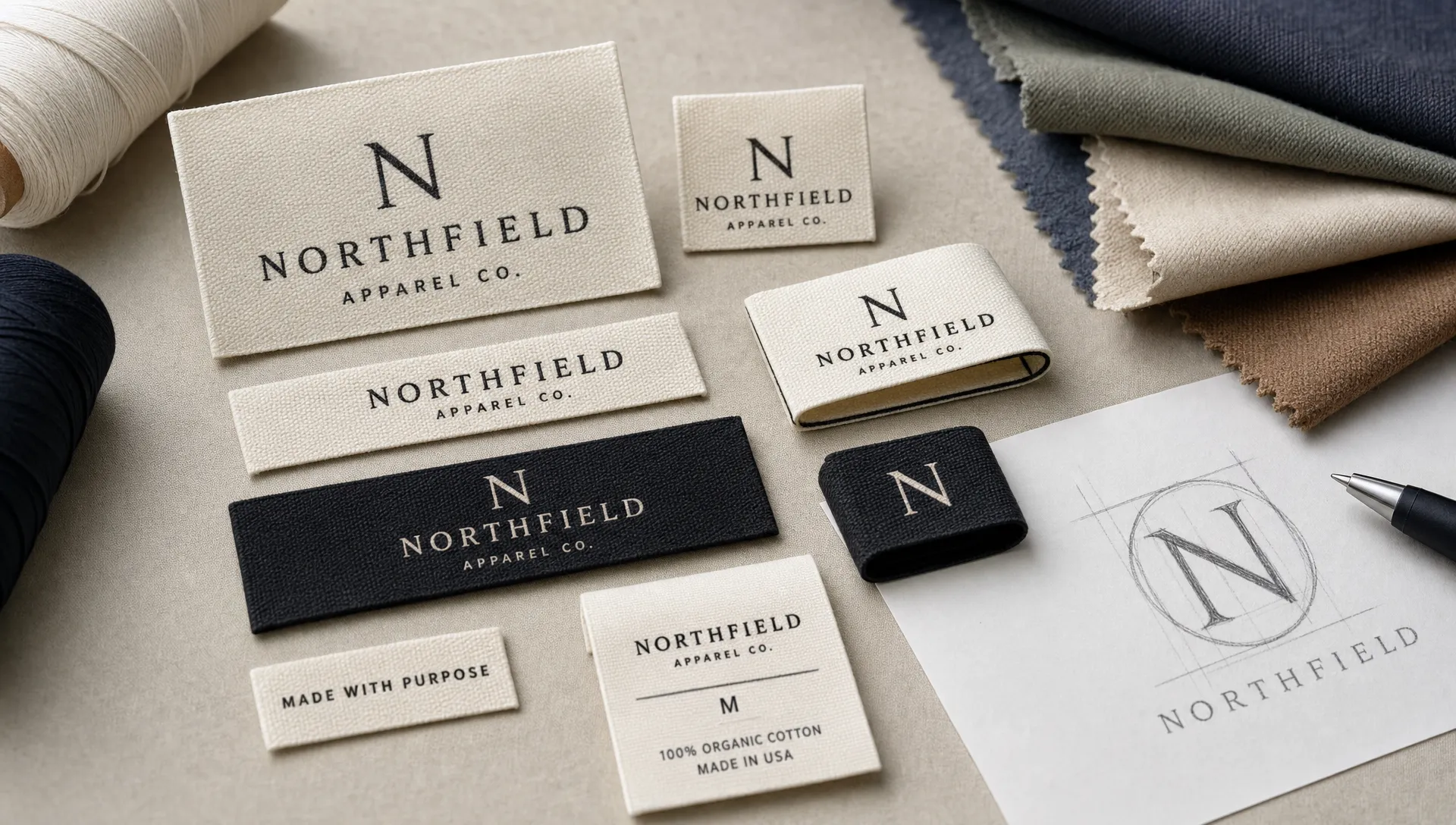
Here are common woven label formats and where they usually fit best:
| Label style | Best for | Why brands choose it |
|---|---|---|
| Flat label | Bags, quilts, outerwear, accessories, packaging | Simple, versatile, easy to sew on all sides |
| Centerfold label | Necklines, side seams, waistbands | Clean finish with seam allowance hidden inside the fold |
| End fold label | Sleeves, hems, blankets, visible brand tabs | Polished edges with a refined horizontal layout |
| Loop fold label | Scarves, beanies, towels, handmade goods | Wraps around an edge for branding on both sides |
| Miter fold label | Hanging products, artisan items, higher-end garments | Angled folded ends create a boutique look |
Placement also matters. A back neck label is traditional for apparel, but a side seam label can feel more modern and discreet. Exterior labels can make a product instantly recognizable, while interior labels create a more subtle ownership experience.
If you are still defining your garment branding system, HiLabels has a helpful overview of custom woven clothing labels for a polished brand look that expands on how label choices affect perceived quality.
Keep your design simple enough to weave well
Woven labels are made with thread, not ink. That difference is important. Fine lines, gradients, tiny text, distressed textures, and photographic effects may look great on a screen but lose clarity when translated into woven threads.
The strongest woven label designs usually rely on clean shapes, strong contrast, and restrained detail. A simplified logo often looks more premium than an overly complex one.
For best results, review your design through the lens of scale. A mark that looks clear at 4 inches wide may become unreadable at 1 inch wide. If your label includes text, print the design at the intended label size and view it from a normal distance. If you have to squint, the customer will too.
Important details to check before ordering include:
- Logo legibility at actual size
- Text size and spacing
- Contrast between background and thread colors
- Whether thin lines can be simplified
- Whether a symbol could replace long wording
- Whether the design still works in fewer colors
If you already have artwork and want to understand the ordering steps, this guide on how to order woven labels with your own logo can help you prepare your file and avoid common setup mistakes.
Choose colors that work in thread, not just on screen
Color is one of the biggest reasons a label feels either cohesive or off-brand. Your woven label should connect with your product palette, packaging, website, and overall brand system.
However, thread color behaves differently from digital color. Screen colors are backlit, while thread reflects light. Texture, weave density, and surrounding colors can all affect how a shade appears. A soft beige thread may look warm and natural on one garment but dull on another. A bright white logo may look crisp on navy but too stark on muted linen.
If your brand has strict color standards, choose the closest thread match and prioritize contrast. Exact digital matching is not always realistic in woven production, but a smart color relationship is more important than a perfect screen-to-thread translation.
For most brands, two to four colors are enough. Too many colors can make a small label look busy, especially when the label includes text. Minimal palettes are often easier to read and more flexible across product lines.
Pick the right size for visibility and comfort
Label size should be driven by function. Bigger is not always better. A label that is too large can feel bulky, irritate the wearer, or overpower a small product. A label that is too small may make your logo unreadable.
Think about three things when deciding size: the amount of information, the placement, and the product scale. A hoodie can handle a larger neck or hem label than a silk camisole. A tote bag may benefit from a bolder exterior label, while a fine knit scarf may need something lightweight and discreet.
As a general principle, the label should be large enough to read but small enough to feel integrated. If you are using a folded label, remember that the visible area may be smaller than the full production size.
Consider how the label will feel against the skin
A label may look perfect and still fail if it feels uncomfortable. This is especially important for T-shirts, childrenswear, activewear, loungewear, sleepwear, undergarments, and lightweight garments.
Comfort depends on label placement, weave, edge finish, thread texture, and how the label is sewn into the garment. A neck label in a fitted tee has different comfort requirements than a label on the outside of a denim jacket.
If the label will touch skin, keep it soft, appropriately sized, and free of unnecessary bulk. For sensitive products, consider whether branding belongs in a side seam, hem, or printed packaging component instead of directly at the neck.
This is also where woven quality matters. Dense, well-made labels tend to look sharper and feel more finished. HiLabels emphasizes superior European loom quality, which is relevant when your label needs to hold up through repeated wear and washing.
Decide what information belongs on the woven label
A woven brand label does not need to carry every detail about the product. In fact, trying to include too much information is one of the most common mistakes.
For many brands, the main woven label should include only the logo, brand name, or a short brand phrase. Product details can be handled separately through care labels, hang tags, packaging, or product pages.
Common label information includes:
- Brand name or logo
- Size marker
- Short tagline
- Collection name
- Website or social handle, only if readable
- Country of origin, when appropriate and compliant
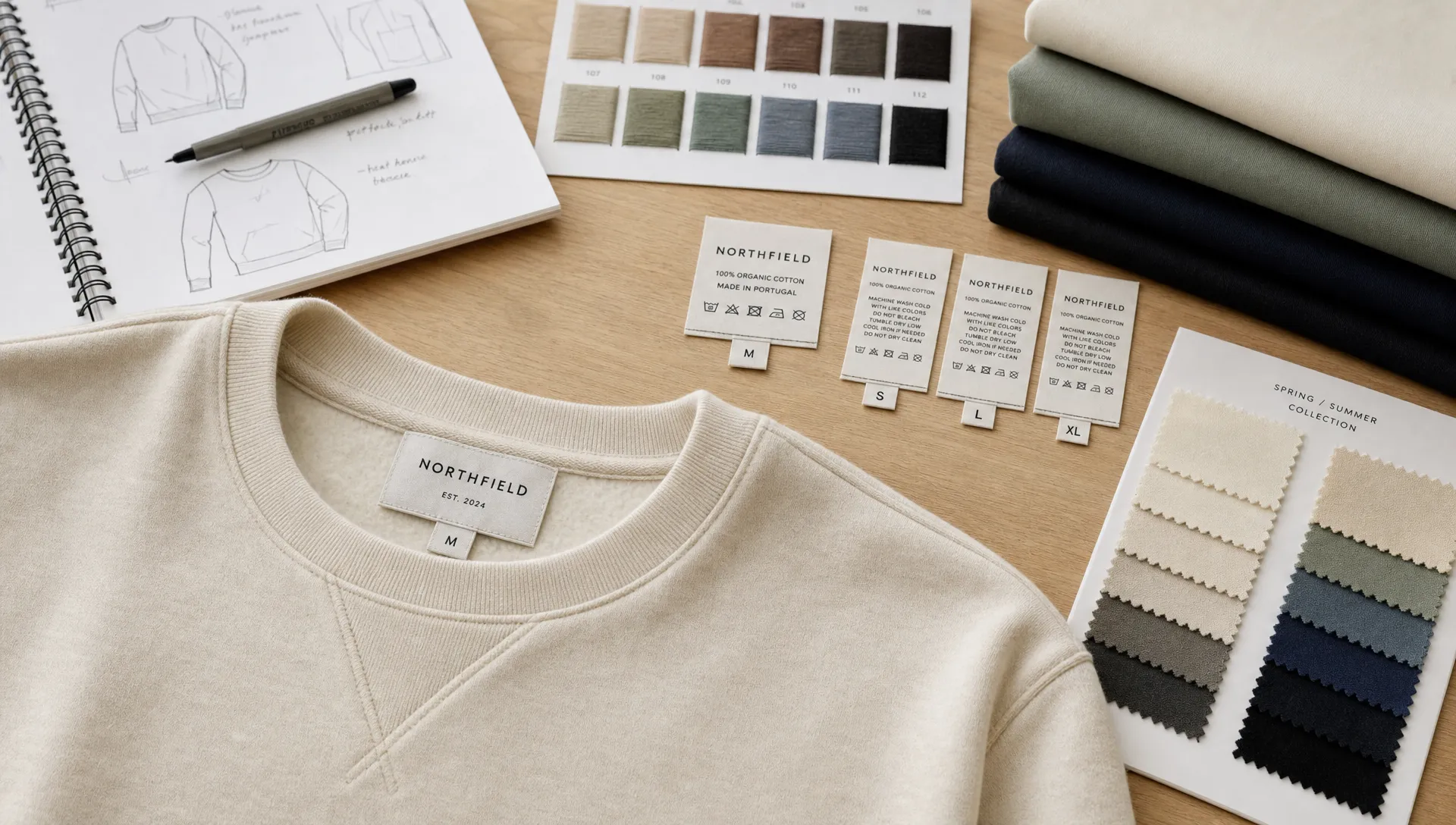
- Care or fiber information on a separate care label
For apparel sold in the United States, labeling may involve requirements for fiber content, country of origin, care instructions, and manufacturer or dealer identity. The Federal Trade Commission provides guidance on clothing and textile labeling, which is worth reviewing if your products are sold commercially.
A practical approach is to separate brand identity from regulatory and care information. Your woven logo label can stay clean and timeless, while your care label handles the details that may vary by product.
Align label quality with your price point
Customers often judge quality through small physical cues. Stitching, fabric weight, buttons, packaging, and labels all contribute to the overall impression of value. If you sell premium products but use a flimsy or poorly designed label, the mismatch can weaken trust.
That does not mean every brand needs the most elaborate label possible. It means the label should match the promise of the product. A minimal black-and-white woven label can feel luxurious if it is well proportioned and cleanly executed. A colorful label can feel high-end if the palette is controlled and the weaving is sharp.
Consider how your label supports your positioning:
| Brand positioning | Label direction | Design priority |
|---|---|---|
| Luxury or boutique | Minimal, refined, subtle texture | Restraint, material feel, precise details |
| Streetwear or merch | Bold, visible, graphic | Recognition, contrast, exterior placement |
| Handmade or artisan | Warm, personal, tactile | Authenticity, small-batch feel, charm |
| Kids or lifestyle | Friendly, colorful, soft | Comfort, playfulness, wash durability |
| Sustainable or natural | Muted, simple, understated | Earthy palette, low visual noise, longevity |
A label is not just decoration. It helps customers decide whether your product is worth the price.
Think beyond one product launch
It is tempting to design labels only for the product you are making right now. But if you plan to expand into new categories, your label system should have room to grow.
A strong brand label can work across T-shirts, hats, bags, jackets, blankets, and packaging. That consistency helps build recognition over time. You may still create variations, such as a small side seam label, a larger outer label, and a care label, but they should all feel like part of the same visual family.
Before finalizing your design, imagine how it would look across multiple products. Will the colors still work? Is the logo flexible? Can the same woven identity support future collections? If not, simplify now rather than redesigning later.
For more on how labels support long-term recognition, see HiLabels’ article on brand woven labels that build recognition with every sale.
Check durability for real-world use
Personalized woven labels are often chosen because they can outlast printed alternatives, especially on garments that are washed repeatedly. But durability still depends on the product use case.
Think about the stress your label will face. A label on a gym hoodie needs to withstand sweat, washing, friction, and stretching. A label on a decorative pouch may have a gentler life. A label on workwear or childrenswear may need extra attention to construction and placement.
Durability is not only about the label itself. Sewing method matters too. A beautifully woven label can still fail if it is attached with weak stitching or placed in a high-stress area without proper reinforcement.
Before ordering in volume, test the label on a sample product. Wash it, wear it, stretch it, fold it, and check how it looks afterward. The goal is for the label to remain readable, secure, and aligned with the garment’s quality over time.
Order with production details in mind
The best label orders are clear, specific, and based on the final use. When submitting artwork or building your label online, provide enough detail for accurate production.
Useful order details include the intended placement, desired fold style, finished dimensions, background color, thread colors, and whether the label will touch skin. If you have a brand guide, use it. If you have a sample garment, measure the available space rather than guessing.
HiLabels offers an online label creation process with artwork upload options, which can make it easier to translate your design into a production-ready label. You can start with the custom woven clothing labels configurator when you are ready to explore sizes, finishes, application methods, and design notes.
Personalized customer service is also valuable at this stage. If you are unsure whether your artwork is too detailed, your label is too small, or your color combination has enough contrast, asking before production can save time and prevent disappointment.
Common mistakes to avoid
Even strong brands make label mistakes when they rush the process. Most issues come from treating the label as an afterthought instead of part of the product design.
Avoid these common problems:
- Using text that is too small to read
- Choosing low contrast colors because they look good on a screen
- Adding too much information to one small label
- Ignoring how the label feels against skin
- Picking a fold style without considering how it will be sewn
- Ordering a large quantity before testing on the actual product
- Designing a label that only works for one item and not future collections
The best labels feel inevitable, as if they always belonged on the product. That usually comes from a clear purpose, simple artwork, careful sizing, and thoughtful placement.
A simple decision framework
If you are stuck between options, use this quick framework. It can help you narrow the choices without overcomplicating the process.
First, define the label’s primary purpose. Is it for recognition, product information, sizing, care, or decoration? Next, choose the placement based on how visible and comfortable the label needs to be. Then simplify the artwork until it is readable at actual size.
After that, select colors for contrast and brand consistency. Choose a fold style that matches your sewing method. Finally, test the label on the real product before committing to a large run.
This sequence keeps the focus on what matters most: a label that looks good, works well, and supports your brand experience.
Frequently Asked Questions
What are personalized woven labels used for? Personalized woven labels are used to add brand identity, sizing, care information, or decorative detail to clothing, accessories, handmade goods, textiles, and packaging. They help products look more professional and recognizable.
Are woven labels better than printed labels? Woven labels are often more durable and premium-looking because the design is made from thread rather than ink. Printed labels can be useful for very detailed artwork or certain care information, but woven labels are a strong choice for long-lasting brand presentation.
What size should my woven label be? The right size depends on placement, product type, and the amount of information included. A neck label, side seam label, exterior hem tag, and bag label may all require different dimensions. Always test legibility at actual size before ordering.
Can I use my logo on a woven label? Yes, but logos often need to be simplified for weaving. Clean shapes, strong contrast, and readable proportions usually produce the best result. Very thin lines, gradients, and tiny details may need adjustment.
Do I need a separate care label? In many apparel situations, yes. A brand label is often best kept simple, while care instructions, fiber content, and other required information can go on a separate care label. If you sell apparel commercially, review applicable labeling rules for your market.
Create labels that make your brand feel finished
The right personalized woven labels can make your products feel more complete, more memorable, and more trustworthy. Start with the purpose, keep the design clear, choose the right size and fold, and think carefully about comfort and durability.
If you are ready to turn your logo or label idea into a finished woven product, HiLabels makes it easy to create custom labels online with professional craftsmanship, artwork upload options, and support from a team with decades of experience.


