How to Choose the Right Size of Labels
Choosing the right size of labels is one of the simplest ways to make a product feel more polished, intentional, and professional. A label that is too small can make your logo hard to read. A label that is too large can overwhelm the garment, irritate the wearer, or look out of proportion on packaging.
The right label size is not just a design preference. It affects readability, comfort, durability, sewing, cost, and brand perception. Whether you are ordering woven labels for apparel, size labels for handmade goods, care labels for garments, branded ribbon for packaging, or patches for accessories, the best size starts with one question: what does this label need to do?
Why the Size of Labels Matters
Labels are small, but they carry a lot of responsibility. They identify your brand, communicate size or care instructions, help customers remember where they bought the product, and can even influence how premium the item feels.
A well-sized label should feel like part of the product, not an afterthought. On a soft T-shirt, that may mean a compact neck label that stays comfortable against the skin. On a canvas tote, it may mean a larger exterior patch that helps the brand stand out. On premium packaging, it may mean a ribbon or woven tag that adds a finishing touch without covering the product.
The ideal size is the point where your label is large enough to communicate clearly and small enough to fit naturally into the product experience.
Start With What the Label Needs to Accomplish
Before choosing dimensions, define the purpose of the label. Different label types need different amounts of space, even if they are used on the same product.
| Label type | Primary job | Size priority | Best placement clue |
|---|---|---|---|
| Brand woven label | Display logo or brand name | Logo clarity and visual balance | Neckline, waistband, hem, side seam, product exterior |
| Size label | Show garment size quickly | Instant readability | Neckline, waistband, side seam, near brand label |
| Care label | Communicate washing, fiber, and origin details | Legible text and enough line spacing | Side seam or interior seam |
| Patch | Add visible branding or decoration | Proportion and durability | Hats, jackets, bags, denim, outerwear |
| Branded ribbon | Support packaging or presentation | Width, repeat pattern, and wrap style | Gift boxes, product bundles, retail packaging |
| Zipper pull | Add a branded functional detail | Grip, durability, and logo recognition | Bags, jackets, pouches, accessories |
A brand label can often be compact if it only contains a simple wordmark. A care label usually needs more height because it contains multiple lines of information. A patch may need to be larger because it is meant to be seen from farther away.
If one label is trying to do too much, the solution is often not to make it bigger. It may be better to split the information across multiple labels, such as a brand label plus a separate size or care label.
Measure the Real Placement Area First
The product should guide the label size, not the other way around. Before choosing dimensions, measure the exact location where the label will be attached.
For apparel, check the usable space at the neckline, waistband, side seam, sleeve, hem, or exterior placement. Leave room for seams, stitching, folds, and natural movement. A label that looks fine on a flat table may feel oversized once the garment stretches, drapes, or curves around the body.
For accessories, consider the shape and structure of the item. A label on a tote bag can usually be larger than a label on a small pouch. A patch on a cap must follow the curve of the front panel. A zipper pull should be easy to grip without interfering with the zipper function.
For packaging, test the label on the actual box, bag, sleeve, jar, bundle, or ribbon wrap. The label should not cover essential product details, block opening points, or make the packaging difficult to handle.
A simple physical test helps: cut a paper rectangle in your proposed label size and place it on the product. If it looks awkward in paper, it will likely look awkward as a finished label.
Let the Artwork Determine the Minimum Size
Your artwork sets the smallest practical size your label can be. This is especially important for custom woven labels because a woven design is created with thread, not ink. Tiny letters, thin lines, detailed illustrations, and tight spacing may lose clarity if the label is too small.
The more detailed the artwork, the more space it usually needs. A simple wordmark can work at a smaller size than a crest, mascot, script logo, or multi-line layout. If your design includes a tagline, website, fiber information, or decorative border, you may need extra width or height to keep everything readable.
A useful rule is to choose the smallest label that still lets the design breathe. Avoid squeezing the artwork to fit a preferred dimension. Instead, simplify the design or increase the label size until the logo, letters, and spacing are clear.
If you are still refining your artwork, HiLabels has a helpful guide with design tips for custom woven labels that explains how simplicity, color, and readability affect the final result.
Common Label Size Starting Points
There is no universal perfect label size, but common ranges can help you plan. These are practical starting points, not fixed specifications. The best final dimensions depend on your artwork, placement, fold type, and product category.
| Label application | Common starting size | Works well for | Sizing note |
|---|---|---|---|
| Main neck label | 1 to 2.5 in wide, 0.5 to 1 in tall | T-shirts, sweatshirts, dresses, handmade apparel | Keep it comfortable and readable at close range |
| Side seam label | 0.5 to 0.75 in wide, 1 to 2.5 in long | Brand tabs, small logos, subtle product details | Narrow labels reduce bulk in the seam |
| Hem label or tab | 0.5 to 1.5 in visible width | Streetwear, kidswear, handmade goods, casual apparel | Check how much of the label will remain visible after sewing |
| Size label | Around 0.5 to 0.75 in in one direction | Adult, baby, kids, or one-size garments | Prioritize quick recognition over decoration |
| Care label | 1 to 1.5 in wide, 2 to 4 in tall | Garments with washing and fiber instructions | More information usually requires more height |
| Exterior patch | 2 to 4 in wide or tall | Hats, jackets, bags, denim, uniforms | Scale the patch to the product surface |
| Branded ribbon | 0.25 to 1.5 in wide | Packaging, gift wrap, retail presentation | Width depends on the box size and how the ribbon is tied |
If you are between two sizes, ask what matters most. If readability is the issue, go larger or simplify the artwork. If comfort is the issue, go smaller, use a different placement, or move some information to a second label.
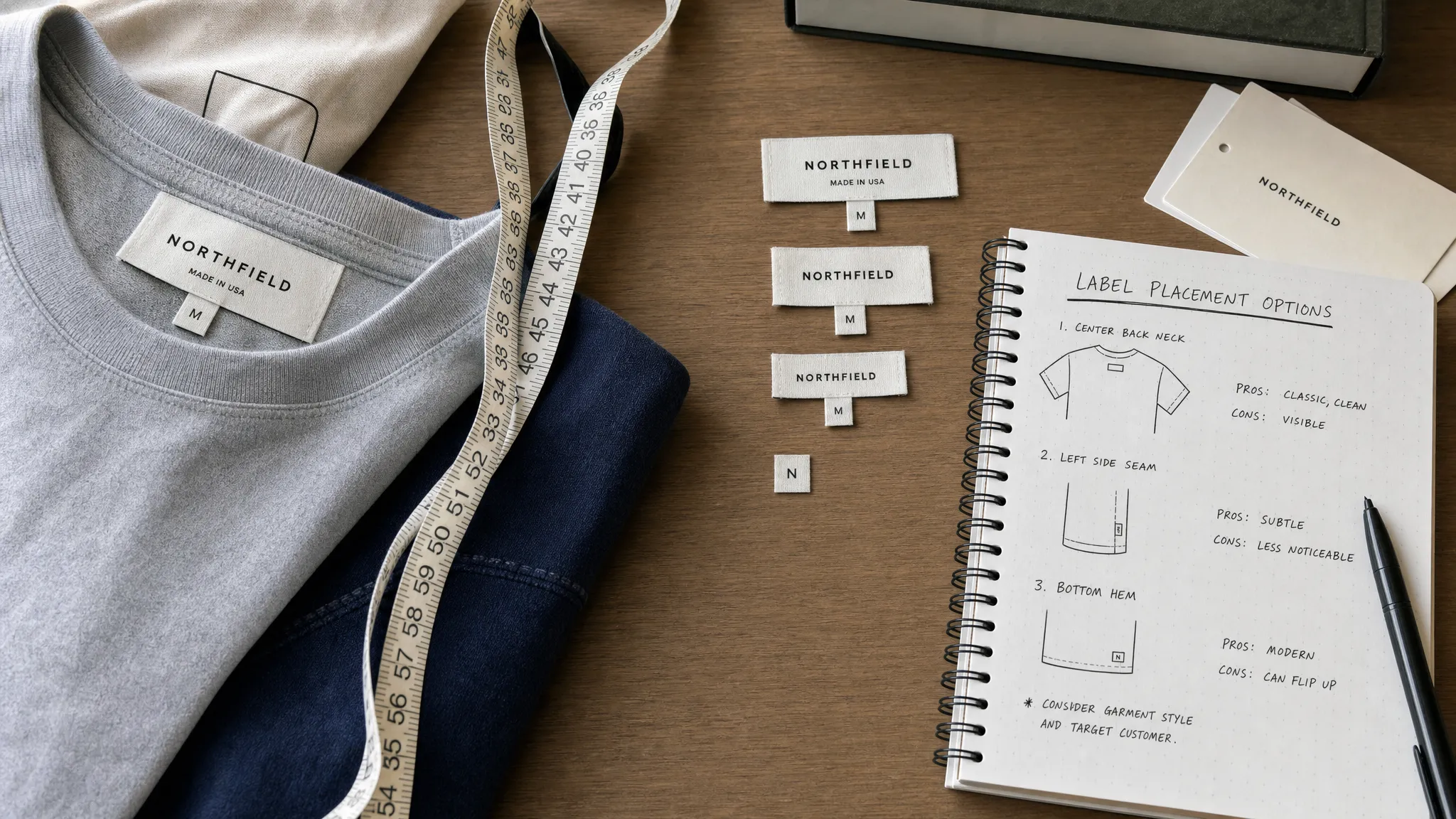
Account for Fold Style Before Approving Dimensions
Fold style changes how much of the label is visible after it is sewn in. This is one of the most common sizing mistakes, especially for first-time label orders.
A straight-cut label shows the full label surface. An end-fold label includes small folded edges that are sewn down, so the visible area may be slightly smaller than the total dimension. A center-fold label is folded in half, which means the final visible height on each side is different from the unfolded height. A loop-fold label wraps around a seam or edge, so front and back placement both matter.
| Fold style | What to consider when sizing | Common use |
|---|---|---|
| Straight cut | Full dimension is visible, but edges need finishing and stitching space | Patches, flat labels, exterior labels |
| End fold | Add width for tucked edges and stitching | Neck labels, hem labels, bag labels |
| Center fold | Unfolded height is split across both sides | Neck labels, side seam labels, brand plus size combinations |
| Loop fold | Front and back may both be visible | Sleeve tabs, hem tabs, seam labels, accessories |
Before approving your proof, confirm whether the listed dimensions refer to the full unfolded label or the final visible area. This small detail can prevent a label that looks correct on screen from feeling too short, too tall, or oddly cropped once sewn.
Size for Comfort, Not Just Appearance
A label can look beautiful and still be wrong if it is uncomfortable. This matters most for garments worn close to the skin, such as T-shirts, baby clothes, underwear, activewear, and lightweight knits.
For neck labels, avoid unnecessary bulk. A large or stiff label may scratch the wearer, flip up, or distract from the garment. For side seam labels, keep the width narrow enough that it does not create a lump in the seam. For kidswear and baby items, comfort should come before decorative impact.
On heavier products, larger labels are often appropriate. Jackets, denim, workwear, bags, caps, and blankets can support larger patches or woven labels because the base material has more structure. Even then, the label should match the scale of the product. A patch that looks strong on a jacket may look oversized on a small pouch.
Match Label Size to Brand Impression
Label sizing sends a subtle message about your brand. Minimal labels can feel refined and modern. Larger labels can feel bold, sporty, utilitarian, or collectible. Small side tabs can suggest understated quality. Oversized patches can create a streetwear or heritage feel.
Think about how your customers will first encounter the product. In a boutique, the label may need to be visible enough to support recognition on a rack. In an online order, the label may be part of the unboxing experience. For handmade goods, the label may reassure customers that the item was made with care and is not a generic product.
Food, gifting, and specialty retail packaging follow the same principle. Premium retailers such as Beef Boutique show how product quality and presentation work together to shape customer expectations. If your packaging needs to feel elevated, a ribbon or label that is too small can feel like an afterthought, while an oversized label can clutter the presentation.
Do Not Forget Care and Compliance Information
If your label carries care instructions, fiber content, country of origin, or other required information, size becomes more than a branding decision. It becomes a readability and compliance decision.
Requirements vary by product type and market, so do not treat a tiny label as a shortcut. If important information becomes difficult to read, consider using a separate care label instead of forcing everything onto your main brand label. This keeps your logo label clean while giving functional details the space they need.
For many apparel brands, a good setup is a main woven brand label, a small size label, and a separate care label. This creates a cleaner visual hierarchy and prevents any single label from becoming crowded.
Standard Size Labels vs. Custom Label Sizes
Standard size labels are useful when you need simple, functional information such as XS, M, XL, baby sizes, or one-size-fits-all. They can save time and keep sizing consistent across your product line.
Custom label sizes are better when your logo, artwork, placement, or brand style needs a specific fit. A custom woven label gives you control over the dimensions, colors, finish, and application method, which is especially important if the label is part of the customer-facing design.
If your logo is the focus, plan the label size at the same time you prepare your artwork. This guide on how to order woven labels with your own logo is a useful next step if you want to understand how artwork, sizing, proofing, and finishing work together.
A Practical Label Sizing Checklist
Use this checklist before placing an order or approving a proof:
- What is the label’s primary job: branding, sizing, care, decoration, or packaging?
- Where will the label be placed on the product?
- How much physical space is available after seams, folds, and stitching?
- Will the label touch the skin or sit on the outside of the product?
- Is the logo simple enough to remain clear at the chosen size?
- Does the label need room for text, symbols, or legal information?
- Does the fold style reduce the final visible area?
- Does the size match the brand impression you want to create?
- Would separate brand, size, and care labels make the product cleaner?
If you answer these questions before choosing dimensions, you will avoid most sizing problems.
Test the Label Size Before You Commit
Digital previews are helpful, but physical testing is better. Print the proposed label at actual size, cut it out, and place it on the product. Try it on different sizes in your range, such as the smallest and largest garment you sell. A label that looks balanced on a large hoodie may be too wide for a small T-shirt.
Take a photo from the distance where a customer would normally see the product. Then check it close up. The label should work in both situations: clear enough to read, but not so dominant that it distracts from the product.
If you are ordering custom woven labels, review your proof carefully. Look at the relationship between the artwork, border, fold, and stitching area. If anything feels crowded, adjust the design before production rather than hoping the finished label will solve the problem.
Frequently Asked Questions
What is the best size for clothing labels? There is no single best size. A main neck label often needs enough room for a readable logo, while a size label can be much smaller. The best size depends on garment type, placement, fold style, and the amount of information on the label.
Can a label be too small? Yes. If the label is too small, text may become hard to read, fine logo details may disappear, and the brand may feel less professional. For woven labels, very small details can be especially difficult to reproduce clearly.
Should size labels be separate from brand labels? Often, yes. Separate size labels keep your main brand label cleaner and make sizing easier for customers to find. This is especially useful for apparel lines with many sizes.
Does fold style affect the size of labels? Yes. Fold style affects the final visible area and the amount of space available for artwork. Always confirm whether your dimensions refer to the full unfolded label or the visible area after sewing.
How much margin should I leave around my logo? Leave enough space for the logo to breathe and for stitching or folding. If the artwork sits too close to the edge, the finished label can look cramped or may lose detail during sewing.
Create Labels That Fit Your Product and Your Brand
The right label size makes your product easier to recognize, more comfortable to use, and more professional from the first impression to long-term wear. Start with purpose, measure the placement, simplify the artwork when needed, and choose a size that supports both function and brand feel.
HiLabels helps brands, makers, and businesses create custom woven labels, care labels, patches, zipper pulls, and ribbons with a user-friendly ordering process, artwork upload options, personalized service, and over 31 years of experience. When you are ready to turn your sizing plan into a finished product, you can build custom woven clothing labels online and choose the details that fit your project.


