How to Keep Luggage Pulls From Rattling During Travel
A faint clink from luggage pulls can become surprisingly distracting when you roll a suitcase through a quiet hotel corridor or carry a bag up stairs. The usual cause is simple: loose metal tabs swing into each other, their sliders or the suitcase shell. You can often reduce that noise with a small, removable restraint or a soft barrier, without replacing the zipper.
Start by identifying what is actually rattling. Then choose a fix that keeps the tabs accessible and lets the zipper operate normally. The goal is to limit unwanted movement, not force the hardware tight.
Identify the contact point before making changes
Close the suitcase and gently rock it while holding the zipper tabs still. If the noise stops, the tabs or their attachment rings are likely responsible. If it continues, check the telescoping handle, wheels, luggage tag and any hanging lock before modifying the zipper.
Next, release one tab at a time. Watch whether it hits the neighboring tab, taps against the shell or rattles within a connecting ring. Those contact points need different fixes: joining two tabs helps with tab-to-tab noise, while cushioning helps when metal strikes a hard surface.
Inspect the attachment as well. A cracked tab, spreading ring or damaged slider is a repair issue rather than a noise-control problem. Avoid squeezing the slider with pliers to silence a rattle. That can interfere with its movement or damage the zipper.
Quiet luggage pulls with soft, removable restraints
Hold paired tabs together with a small elastic loop
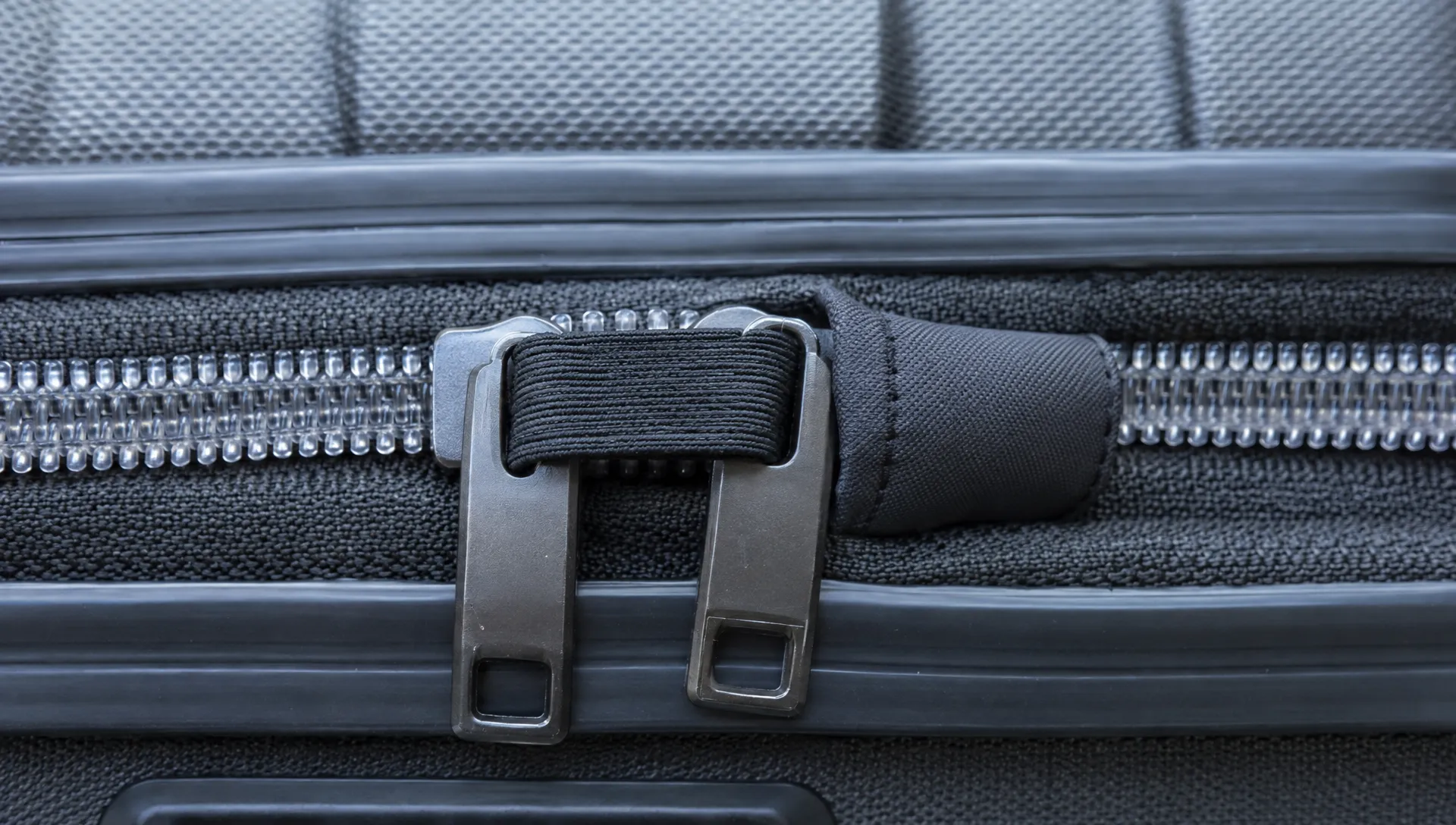
For a compartment with two sliders that meet when closed, a small elastic loop can reduce independent movement. With the zipper fully closed, gently wrap the loop around both pull tabs so they rest together rather than swinging apart.
If the tabs have suitable openings, you can pass a thin loop through those openings to help retain it. Keep the elastic outside the slider mechanism and away from the zipper teeth. It should hold the tabs lightly, not pull the sliders sideways or keep a locking tab raised.
Before traveling, remove and replace the loop several times. You should be able to open the compartment easily without stretching the elastic excessively. A brittle hair tie or an overstretched band is not a dependable travel fix.
For luggage pulls that still strike the suitcase shell after being joined, add a soft contact barrier rather than tightening the loop further.
Cushion the surface that makes contact
A small fabric cuff or a removable silicone sleeve can soften contact between a metal tab and a hard surface. The covering should fit the exposed tab, stay attached during movement and leave its pivot unobstructed.
For a temporary solution, a short piece of fabric tape on the contact face may help. Test it on an inconspicuous area first, since adhesives can leave residue or affect some finishes. Do not wrap tape around the slider body, cover the zipper teeth or block an opening needed for a lock.
Cover only what needs cushioning. A bulky wrap can make a tab difficult to grip or cause it to catch on neighboring fabric. Avoid loose padding tucked behind the tabs, which can fall out or enter the zipper path.
Secure a single tab to a suitable nearby loop
When one long tab swings freely, joining two tabs is not an option. If the bag already has a nearby fabric loop, a short, removable hook-and-loop strap may hold the tab against it during transit.
Use an anchor close enough that the strap does not tug on the slider or distort the zipper. Keep the rough side of the strap away from delicate fabric. Remove the restraint before opening the compartment.
Do not puncture the suitcase shell or stitch through the zipper tape just to create an anchor. If there is no suitable attachment point, cushioning or replacing the tab is usually the simpler approach.
Check loose connections without bending the slider
A pull tab may be attached directly to the slider or connected through a separate ring. That extra connection can create another source of metal-on-metal noise.
If a removable connecting ring is worn or spreading, a compatible replacement may reduce excess movement. However, some clearance is necessary for the tab to pivot. Trying to eliminate every bit of movement can leave the zipper awkward to operate.
When luggage pulls rattle at their attachment points, inspect the connection before adding more padding. A damaged component should be repaired or replaced rather than concealed under tape.
Do not pry open a fixed attachment bridge or dismantle a spring-loaded locking mechanism. If you are unsure how the tab attaches, check the manufacturer's guidance or use a luggage repair service. HiLabels' guide to replacing a zipper pull without damaging the slider explains the distinction between a replaceable tab and hardware that needs more careful attention.
Choose a quieter replacement when temporary fixes are inconvenient
If you open the same pocket frequently, removing an elastic loop each time may become annoying. A compatible replacement tab with less exposed metal or fewer dangling connections can be a better long-term solution.
The attachment matters as much as the grip material. A soft grip hanging from several metal rings may still rattle, while a compact metal tab with a cushioned contact surface may be relatively quiet.
| Pull option | Possible noise advantage | What to check |
|---|---|---|
| Cord pull with no metal connector | Removes a hard hanging tab as a contact source | Cord fit, knot security and compatibility with the attachment |
| Fabric pull | Provides a soft gripping surface | Fraying, attachment strength and whether it catches nearby fabric |
| Rubber or silicone-covered grip | Cushions contact at the covered area | Any exposed metal connector and clearance around the slider |
| Shorter metal tab | May have less reach to strike nearby surfaces | Comfortable grip and clearance for any existing lock |
Replacing luggage pulls with cord or fabric can reduce hard contact, but only if the original metal tab is safely removable. Tying cord onto an existing metal tab improves grip without necessarily eliminating its rattle.
Choose a length you can comfortably grasp, including with gloves if needed. For a closer look at material and attachment trade-offs, see how to pick backpack zipper pulls that last, which covers considerations that also apply to travel bags.
Test the fix with the suitcase packed
An empty suitcase does not always behave like a packed one. Packing changes the shape of soft luggage and may change where tabs rest against the bag. Test your solution with a representative load, without overfilling the compartment.
Roll the suitcase across both smooth flooring and a slightly uneven surface. Carry it by the handle, turn it on its side and gently rock it. Listen for remaining contact and check whether the restraint or cushion shifts.
Then open and close the zipper several times. It should move as it did before, with no new resistance. If a tab must lift to release an auto-lock mechanism, make sure your covering does not interfere with that action or hold the tab permanently raised.
A successful fix keeps luggage pulls quieter while preserving easy access. Remove or revise anything that catches the zipper, pulls a slider out of position or requires excessive force to undo.
Repeat the check after the first trip. Elastic can stretch, tape can lift and fabric coverings can wear at their edges.
Avoid fixes that create new travel problems
Lubricant is not the first answer to tabs striking each other. It does not prevent impact, and excess product can transfer onto the bag or collect dirt. If the zipper itself is difficult to operate, address that separately using the manufacturer's maintenance guidance.
A padlock is not a guaranteed noise fix either. It may limit movement between two tabs but also adds another hard object that can knock against the suitcase. Use a lock for its intended purpose, not simply as a weight to hold tabs down.
If your bag uses paired locking hardware, understanding how interlocking zipper pulls work can help you avoid covering or obstructing the parts that need to engage.
Skip permanent glue, sharp wire ties and heat-applied coverings as quick travel fixes. Removable options are easier to inspect, adjust and take off when you need access.
Frequently Asked Questions
Can I use a hair tie to stop the rattling? Yes, a small hair tie can temporarily hold two tabs together when the zipper is closed. Keep it clear of the slider mechanism and teeth, and replace it if it becomes stretched or brittle. It should be easy to remove without tools.
Will adding cord make metal luggage pulls silent? Not necessarily. Cord tied onto an existing metal tab does not stop that tab from striking another surface. To address the noise, restrain or cushion the metal, or replace the tab if the attachment allows safe removal.
Does rattling mean the zipper is failing? Not by itself. Freely moving tabs can make noise even when the zipper works properly. Cracks, spreading attachment rings, missing parts or teeth that separate behind the slider deserve repair attention rather than a simple noise fix.
What if the zipper tabs still hit the shell after I join them? Joining the tabs limits their movement relative to each other, but the pair may still swing as a unit. Add a securely attached soft covering at the contact point or use a suitable nearby fabric loop to restrain them without tension on the zipper.
Plan quieter details for custom travel bags
For brands developing travel gear, specify pull length, attachment clearance and likely contact points alongside the artwork. Test the assembled bag rather than judging the pull alone.
HiLabels offers custom zipper pulls and personalized customer service. Discuss your design and attachment requirements before ordering, then assess noise and usability on the finished bag. A branding detail should be comfortable to use as well as look right.


