How to Measure a No 10 Zipper Slider Before Ordering
Ordering a no 10 zipper slider starts with measuring the zipper chain, not the pull tab or the outside of the slider. The size marking is useful, but a replacement must also match the zipper’s construction, profile and operating style. Two sliders marked “10” can fit different chains.
Before ordering, gather a metric ruler or digital caliper, your original slider if available and a phone for close-up photos. Keep the zipper assembled while you inspect it. Removing stops or forcing off the slider too early can turn a straightforward identification job into a larger repair.
What the No. 10 marking actually tells you
A zipper’s size number generally relates to its approximate closed-chain width in millimeters. For No. 10, think of a nominal size around 10 mm, not a universal specification requiring every chain to measure exactly 10.00 mm.
The chain is the pair of interlocked rows of teeth or coil elements. It does not include the fabric tape alongside them. The slider is the moving body that joins and separates those rows; the pull tab is the piece you hold.
If the zipper still closes properly and only its tab has broken, you may need to focus on replacing the zipper pull without damaging the slider rather than ordering a new slider body.
How to measure for a no 10 zipper slider
Record measurements in millimeters and keep your observations separate from the supplier’s size designation. A useful record says “closed-chain width: measured value” rather than simply “looks like a size 10.”
Identify the chain construction first
Look at the elements that interlock, not the material of the slider body. A metal slider can run on a synthetic zipper.
| Chain construction | What to look for | What to tell the supplier |
|---|---|---|
| Coil | A continuous spiral forming the interlocking elements | Coil zipper, plus whether the coil faces outward or inward |
| Molded plastic | Separate molded plastic teeth attached along the tape | Molded-tooth zipper, with clear tooth photos |
| Metal | Individual metal teeth attached to the tape | Metal-tooth zipper, plus any maker or series markings |
If the zipper has a smooth-looking outer face, inspect its reverse side. A reverse-coil construction may hide the coil from the normal viewing side. Do not assume it is molded plastic because the spiral is not immediately visible.
When selecting a no 10 zipper slider, matching this construction is essential: a similar width does not make coil, molded and metal chains interchangeable.
Measure across the closed chain
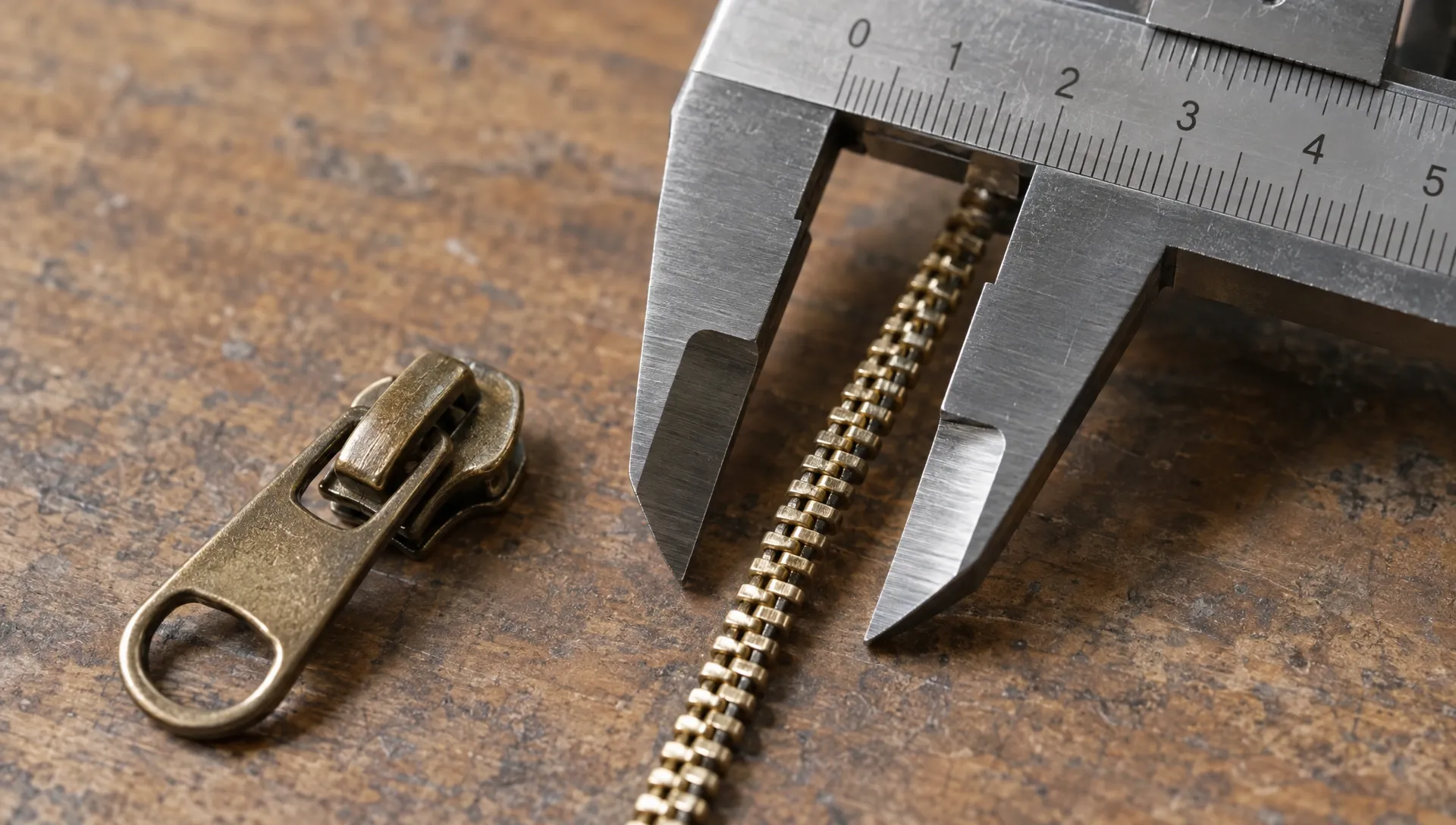
Close an undamaged section and lay it flat without stretching the tape. Position the caliper jaws across the chain, perpendicular to its length. Touch the outer edges of the interlocked elements gently, excluding the fabric tape on both sides.
Use light contact. Compressing a flexible coil can change the reading. With a ruler, align one edge of the chain with a clear millimeter mark and view it straight from above to reduce reading error.
Measure at three intact locations away from stops, seams and damaged areas. Record the readings rather than rounding everything to “10.” If they differ noticeably, check that you have not included tape or measured at an angle.
Do not add the widths of two open rows together. The elements overlap when engaged, so that total does not represent closed-chain width. If the zipper cannot close anywhere, identify the manufacturer and series or send an intact chain sample for matching.
Record the original slider’s markings and dimensions
Photograph the top, underside and both ends of the original slider. Look for a size number, manufacturer name, logo or additional letters. Copy the markings exactly; letter codes are not universal across manufacturers.
For a no 10 zipper slider, the original body’s measurements are supporting evidence, not the primary size test. If a supplier requests them, record body length and width separately from the pull tab, and follow the supplier’s drawing for measurement points.
Do not use pull-tab length to determine zipper size. A large decorative tab can be attached to a relatively small slider, while a substantial slider may have a short tab.
If the old body is cracked, distorted or heavily worn, note that condition. Its measured dimensions may no longer reflect the original specification.
Document orientation and the zipper ends
Take one photo of the zipper as it normally sits on the item and another showing the reverse side. Include the slider’s position and the direction in which it closes the zipper.
Also photograph the ends. A separating jacket zipper has a pin-and-box arrangement, while a closed-end zipper has a different termination. These details help the supplier understand the assembly and help you determine how a replacement could be installed.
For a bag with two sliders, photograph both together. Do not assume the arrangement from a close-up of just one body.
Match the locking action and pull arrangement
Once the chain is identified, choose the operating features. A no 10 zipper slider can have the correct chain fit but still be wrong for the way the item is used.
Locking action and pull arrangement are separate choices. A locking slider resists unintended travel when its locking mechanism is engaged; a non-locking slider does not provide that same restraint. Follow the original specification rather than choosing solely by appearance.
| Feature | How to recognize or confirm it | Why it matters |
|---|---|---|
| Locking slider | Markings, supplier specification or observed locking action | Helps prevent unwanted slider movement |
| Non-locking slider | Supplier specification confirms no locking mechanism | Allows movement without releasing a lock |
| Single pull | One tab on one face of the body | Provides access from that side |
| Double pull | Tabs accessible from both faces of one body | Allows operation from either side |
| Two-slider arrangement | Two separate slider bodies on one zipper | Must match the intended opening direction and assembly |
A double-pull slider is not the same thing as a two-way zipper. Count the slider bodies and document how they face each other rather than relying on those terms alone.
Build an order specification the supplier can check
Send measurements and photographs together. A width reading without a view of the chain leaves out its profile; a photograph without scale can make neighboring sizes difficult to distinguish.
Before ordering a no 10 zipper slider, give the supplier a compact identification record:
- Chain construction: Coil, reverse coil, molded plastic or metal, based on inspection.
- Measured width: Closed-chain readings in millimeters, taken at three intact locations.
- Existing markings: Every visible number, letter, logo and manufacturer name.
- Operating style: Locking or non-locking if known, plus single or double pull.
- Assembly details: One or two slider bodies, their orientation and the zipper-end construction.
- Photographs: Closed chain beside a ruler, reverse side, original slider from several angles and both zipper ends.
If a detail is unknown, label it “unknown.” Guessing a manufacturer or locking style can send the matching process in the wrong direction.
Ask the seller to confirm compatibility with the identified chain family or series, not merely with “size 10.” If there are no readable markings, ask whether they can match a physical sample before you order a batch.
Check a sample before committing to quantity
For production work or multiple repairs, a small sample order is safer than assuming every size-marked replacement will work. This also applies to branded components: a YKK marking, for example, does not by itself identify every detail of the compatible chain and slider combination.
Test the proposed no 10 zipper slider on an intact matching chain or have a repair professional fit it. It should join the elements consistently without force, snagging or repeated separation behind the body.
Confirm that it travels in the intended direction, provides the required access and locks if specified. Test it across the usable zipper length, not just a short, easy section.
Do not force a binding slider or squeeze its body to make an uncertain match work. Resistance can indicate the wrong profile, damaged elements or an installation problem. After compatibility is confirmed, follow an appropriate zipper slider replacement procedure for the assembly.
Decide whether a slider replacement is enough
A new slider can help when the original body is worn or damaged and the remaining zipper components are sound. It cannot repair missing teeth, a broken coil or fabric tape that has torn away from the elements.
Inspect the entire chain before ordering. Look for localized damage, loose elements, frayed tape at attachment points and damaged stops. On a separating zipper, check the insertion pin and box as well.
If the zipper repeatedly opens behind the slider, wear in the body is one possible cause, but damaged or mismatched chain elements can produce similar symptoms. Do not treat that symptom alone as proof that a replacement slider will solve the problem.
When the chain or separating hardware is damaged, a zipper repair specialist can determine whether component repair is practical or the whole zipper should be replaced.
Frequently asked questions
Should a no 10 zipper slider fit a chain measuring exactly 10 mm? Not necessarily. No. 10 is a nominal size designation, and actual measurements vary with construction and product series. Use the reading to support identification, then confirm the manufacturer’s compatible slider specification.
Can I measure the slider opening instead of the chain? Do not use the opening as your main sizing method. Its internal geometry is difficult to measure accurately, and wear can alter it. Closed-chain width, construction and original markings provide a better starting point.
Will any No. 10 YKK slider fit a No. 10 YKK zipper? Do not assume so. Confirm the chain type and series, orientation and slider function. A shared brand and nominal number are useful clues, not a complete compatibility specification.
What if the original slider is missing? Measure an intact closed section if one remains, photograph both faces of the chain and look for identification elsewhere on the zipper. If the chain cannot be measured closed or positively identified, ask the supplier to assess a sample.
Confirm fit before adding branding
The safest order for a no 10 zipper slider combines an actual chain measurement with construction details, markings and supplier confirmation. Keep that functional specification separate from the decorative pull-tab design.
For branded bags or apparel, HiLabels offers custom zipper pulls and other branding products. Confirm the pull’s attachment requirements against your chosen slider before finalizing the design, so the branding complements hardware that already fits.


