How to Select Jacket Pulls for Cold-Weather Outerwear
Cold-weather outerwear asks more from a zipper than a lightweight hoodie ever will, and jacket pulls are the part your customer touches every time they seal out wind, snow or freezing rain. A good pull has to be easy to find, comfortable with gloves, strong enough for stiff zippers and aligned with the jacket’s visual identity. When it fails, feels flimsy or disappears under a storm flap, the whole garment can seem less reliable.
For apparel brands, private-label manufacturers and outerwear designers, the best choice is not always the most decorative one. Winter garments need trims that survive moisture, abrasion, low temperatures and repeated tugging. The right pull should make the zipper easier to use without catching on branches, backpack straps, seat belts or other layers.
Key Selection Criteria for Jacket Pulls in Winter Conditions
Start by defining the jacket’s actual environment. A city parka, ski shell, workwear jacket and children’s snow coat may all need different pull designs, even if they use the same zipper size. Urban outerwear can prioritize a premium hand feel and branding, while alpine or utility garments often need a larger grip, quieter movement and better control with insulated gloves.
The zipper itself matters too. Waterproof and water-resistant zippers can feel stiffer than standard coil zippers, especially in cold weather. A tiny decorative tab may look clean on a sample, but it may not give enough leverage once the jacket is worn outdoors.
Match the pull to the wearer’s hands
Cold reduces dexterity. Add gloves and a hurry, and a small zipper tab becomes frustrating fast. If the jacket is meant for skiing, snowboarding, workwear or commuting in harsh climates, prioritize a pull that can be grabbed by feel rather than sight.
In practice, jacket pulls for parkas and technical shells should have enough length, texture or loop space to let the user operate them without pinching the metal slider. That usually means avoiding extremely thin tabs on center-front zippers, chest pockets and high-use hand pockets.
Compare common cold-weather materials
Material choice affects grip, noise, weight, perceived value and durability. No single material is best for every jacket, so choose based on the use case and the jacket’s price position.
| Pull material | Best cold-weather use | Strengths | Watchouts |
|---|---|---|---|
| Metal | Premium parkas, fashion outerwear, heavy-duty jackets | Strong, polished, long-lasting feel | Can feel cold to the touch and may make noise |
| Rubber or soft PVC style | Sportswear, kids’ jackets, rainwear-inspired outerwear | Good grip, color flexibility, comfortable handling | Low-quality versions may stiffen or crack over time |
| Cord or paracord | Ski shells, hiking jackets, workwear | Easy to grab with gloves, lightweight, flexible | Ends need secure finishing to prevent fray |
| Woven or fabric tab | Branded lifestyle outerwear, lightweight insulated jackets | Soft hand feel, strong branding space, less clatter | May absorb moisture if not specified correctly |
| Leather-style tab | Fashion outerwear, heritage jackets | Warm look, premium texture | Not ideal for repeated saturation unless designed for it |
For a deeper material-by-material comparison, HiLabels has a useful guide to the best zipper pulls for jackets in 2026 that looks at jacket categories and trim styles in more detail.
Grip, Size and Shape: The Glove Test
The simplest way to evaluate jacket pulls is to test them the way the customer will use them. Put on the thickest glove that matches the jacket’s intended season, then open and close the center-front zipper, chest pockets, sleeve pockets and hand pockets. If the user has to remove a glove, the pull is too small or too smooth for that application.
A practical winter pull often has one of three grip advantages: a loop that a finger can hook into, a textured surface that prevents slipping or a shape large enough to pinch through gloves. Flat metal tabs can work well on fashion jackets, but technical garments often need more surface area or an attached cord.
Choose length without creating snag risk
Longer is not automatically better. A pull that hangs too far from a pocket zipper can catch on straps, gloves, branches or chair arms. This is especially important for ski and outdoor jackets, where dangling trims can interfere with motion.
For many adult outerwear styles, a pull length in the range of roughly 2 to 3.5 inches can be a useful prototype range, depending on zipper placement and glove thickness. Children’s jackets, minimalist shells and interior pockets often need shorter pulls. Always test the length on an actual garment, not just on a flat trim card.
Check the slider opening before choosing an attachment
A pull design is only useful if it fits the slider cleanly. Some zipper sliders have a small hole suited to cord loops, while others work better with a split ring, metal connector or molded tab. If the attachment is forced, it can twist, scrape the slider finish or weaken under repeated use.
When a cord-based solution is appropriate, consider diameter, knot style and end finishing together. HiLabels covers those decisions in its guide on how to choose a zipper pull cord for bags and outerwear, which is especially relevant for performance jackets and gear-inspired apparel.
Attachment Methods That Survive Winter Wear
Attachment is where many trims fail. The main body of the pull may be strong, but the loop, ring or connector takes the stress each time the wearer yanks a stiff zipper closed. Cold weather can add load because zippers may be harder to move when fabric is wet, icy or compressed by layers.
Cord loops are flexible and quiet, which makes them popular for outdoor jackets. Metal connectors feel premium and are often suited to fashion outerwear. Molded or rubberized attachments can add comfort and grip, provided the material remains flexible in cold conditions.
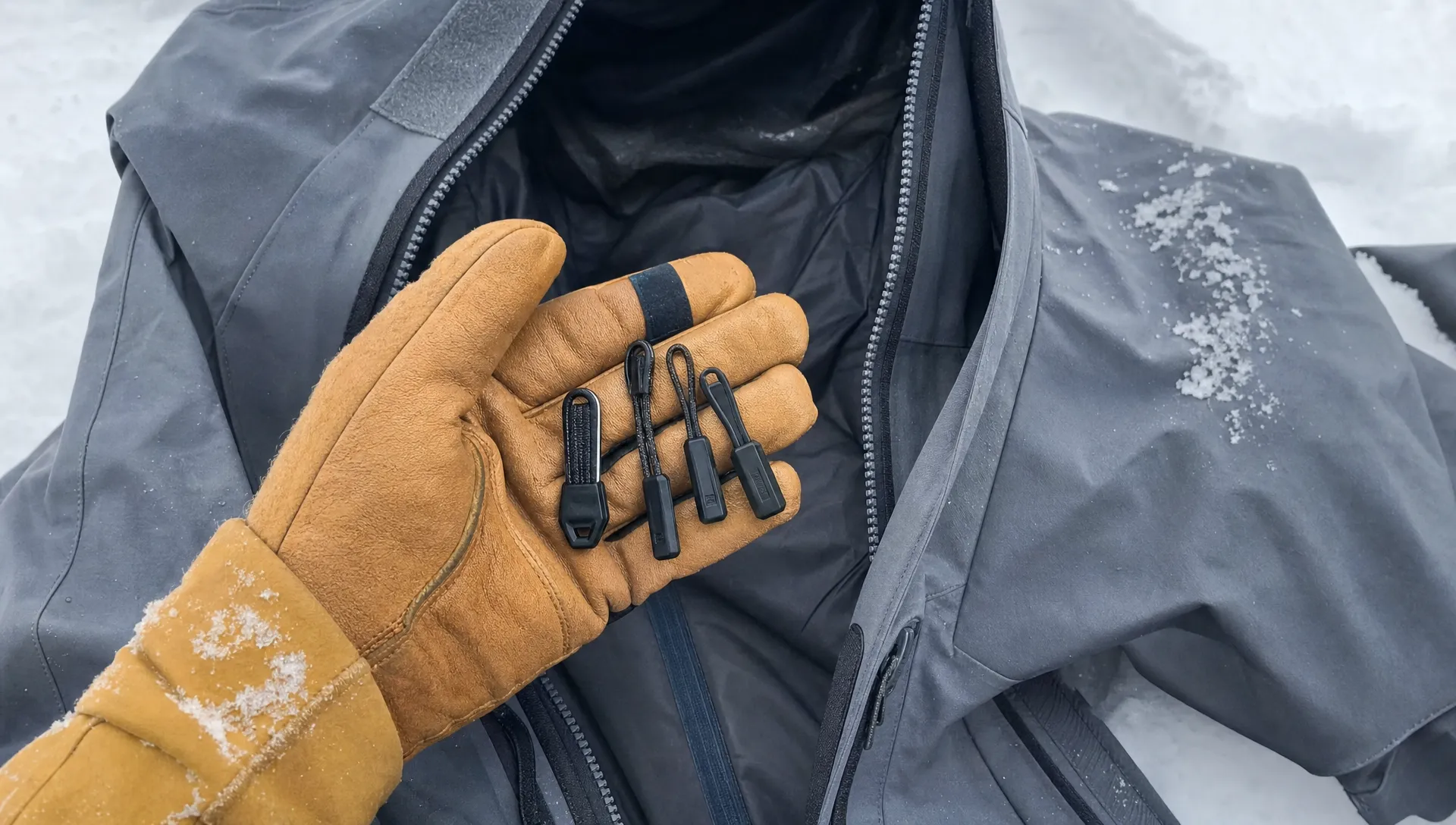
Before placing a larger production order, check how the attachment behaves after repeated pulling from different angles. Users rarely pull perfectly straight. They tug sideways, use one hand while walking or grab the zipper through a bulky glove.
Branding Custom Jacket Pulls Without Hurting Performance
Custom jacket pulls can turn a functional trim into a brand detail, but branding should never make the garment harder to use. The most successful designs keep the logo legible, the shape easy to hold and the material appropriate for the jacket’s environment.
On premium parkas, a small debossed or engraved mark may look more refined than a large logo. On sportswear, a high-contrast color or textured rubber-style surface can make the pull easier to locate. On children’s outerwear, color coding can help distinguish pockets from the main zipper.
Keep logo placement realistic
A zipper pull is a small moving object. Fine lettering, thin lines and complex artwork can lose clarity once scaled down. If your logo depends on small details, consider simplifying it for the pull or using an icon, initials or brand mark instead.
Metal pulls can give a jacket a more substantial feel. If that direction fits your product line, the HiLabels article on metal zipper pulls that upgrade bags, jackets and gear explains where metal works best and where a softer material may be more practical.
Coordinate with labels, patches and other trims
A pull should feel like part of the jacket’s trim system, not an afterthought. Color, finish and scale should connect with woven labels, patches, zipper tape, drawcords and snaps. A matte black rubber pull may suit a technical shell, while a brushed metal tab may feel more consistent on a wool-blend coat.
If the jacket already has a bold sleeve patch or chest logo, the pull can be more understated. If the garment is minimal, a branded pull may be one of the few touchpoints that communicates quality.
Durability Checks Before You Approve Production
A sample can look excellent on a desk and still fail in winter use. Test the pull on the garment, with the correct zipper, lining, storm flap and pocket construction. The more realistic the test, the fewer surprises you will see after launch.
Use these checks before approving jacket pulls for cold-weather production:
- Pull the zipper repeatedly with gloves, from straight and side angles.
- Place samples in cold conditions, then test flexibility, grip and comfort.
- Rub the pull against zipper tape, shell fabric and pocket edges to check abrasion.
- Test wet handling if the jacket is intended for snow, rain or outdoor work.
- Confirm the pull does not damage nearby fabric, labels, linings or coating.
For branded trims, also review color consistency under daylight and indoor light. A pull that looks black in the office may read as dark navy outdoors, and small finish differences can be noticeable when placed next to zipper tape or snaps.
Common Mistakes When Selecting Cold-Weather Pulls
Many problems come from treating zipper pulls as decoration only. Outerwear buyers notice small frustrations quickly because they interact with zippers throughout the day.
| Mistake | Why it matters | Better approach |
|---|---|---|
| Choosing a pull that is too small | Gloves make tiny tabs hard to operate | Test with real winter gloves |
| Prioritizing shine over grip | Smooth surfaces can slip when wet | Add texture, loop space or a softer touchpoint |
| Ignoring noise | Metal-on-metal movement can irritate users | Use cord, rubberized parts or quieter connectors where needed |
| Using one pull for every zipper | Pocket zippers and main zippers have different needs | Size each pull by placement and function |
| Approving artwork at full scale only | Details can disappear when reduced | Review actual-size proofs and samples |
The best trim choice balances brand, function and garment context. If a winter jacket is designed for serious outdoor use, performance should lead. If it is a lifestyle coat, feel and finish may carry more weight, but the pull still needs to work in cold hands.
When to Choose Bespoke Pulls Instead of Stock Options
Stock trims can be useful for quick sampling, repairs or low-volume projects. They let you compare grip, weight and scale before committing to a custom version. For finished outerwear collections, bespoke pulls often make more sense because they can align with your color palette, logo system and target user.
Custom jacket pulls are especially valuable when the jacket sits at a higher price point, belongs to a branded uniform program or needs a consistent trim story across multiple styles. They can also help separate your product from generic outerwear that uses standard slider tabs.
When preparing artwork, keep the design simple and provide clear specifications for size, color, material, finish and attachment method. If you are also developing woven labels, patches or care labels, coordinate those pieces early so the final garment feels intentional from the outside to the inside.
Frequently Asked Questions
What size should jacket pulls be for winter coats? There is no universal size, but many adult winter jackets benefit from a pull that is large enough to grip with gloves without dangling excessively. Prototype on the actual zipper and garment before approving final dimensions.
Are metal pulls good for cold-weather jackets? Metal pulls can be durable and premium, especially on fashion parkas and heavy outerwear. For technical or very cold applications, consider whether the metal feels too cold, adds noise or needs a cord extension for better glove use.
Do cord pulls work better than molded tabs? Cord pulls are often easier to grab with gloves and can be quiet, lightweight and flexible. Molded tabs may offer better logo visibility and a more finished brand look. The better choice depends on the jacket’s use, style and zipper placement.
Can jacket pulls carry a logo without reducing usability? Yes, as long as the logo is scaled properly and does not compromise grip. Simple marks, clean lettering and high-contrast details usually work better than complex artwork on a small moving trim.
Create Winter Outerwear Details That Feel Built to Last
The right pull gives a cold-weather jacket a more reliable feel every time the wearer zips up. It should be easy to find, comfortable to grip, strong under repeated use and visually aligned with the rest of the garment.
HiLabels helps brands create high-quality custom woven labels, patches, ribbons, care labels and zipper pulls with a streamlined online ordering process. If you are developing outerwear trims for a new collection, start by matching function to fabric, zipper type and user environment, then explore custom branding options through HiLabels to bring the details together with a professional finish.


